Wednesday, February 07, 2007
Wednesday, September 13, 2006
The last ever post here
Dear folks. I have defected to Seed Blogs on a promise of fame, fortune and women. So this will be my last ever post at this site. The new link is here, and the news feed in Atom form is here. It's been fun, so drop by for a chat.
I will repost some oldies from here to begin with, and continue our discussions.
Friday, June 09, 2006
A blogging delay
Dear readers, for reasons that will shortly become clear, there is a blogging delay here. Hmm... "blogging" in that context sounds like a swear word... "another blogging delay! Dammit!"
Stay tuned and in a day or so All Will Be Revealed.
Monday, June 05, 2006
Biologically feasible political systems
I often wonder what goes through the minds of those who propose utopian political ideals that turn out to become the worst of all possible dystopias, like Leninism or Maoism, or for that matter the extreme laisse faire capitalist conservatism. For it appears to me that these systems would work just fine, if only they didn't involve any human beings. And that raises an interesting question in my mind, and I hope, yours too. What sorts of political systems are biologically feasible for human beings? As Aristotle said, Man is a Political Animal, but what sort of political animal?
Any political system that relies upon purely rational behaviours, for example, is right out. It is often noted that economic and political behaviours are like the games of game theory - any system that relies on a rational outcome, is vulnerable to the free rider effect, as in Garrett Hardin's Tragedy of the Commons. Here's a case in which a shared common resource (the commons, on which each farmer may graze on sheep) is systematically destroyed. One farmer (the freerider) thinks to get an edge on his competitors and graze two sheep. The other soon find that to keep up, they must do this also. Eventually, the commons is overgrazed, but every participant in its destruction has acted in a rationally self-interested manner.
But worse than this, it may pay not to be rational. Suppose you have a Vulcan society. Each is given according to ability calculated rationally, and each accepts this, in that, as Spock said channelling James Mill and Jeremy Bentham, the needs of the many outweigh the needs of the few. All it takes to subvert that little society, in the absence of draconian sanction, is for one member to act irrationally, and take their own needs as paramount. They will cause others to rationally reflect that if that is happening, there will be a point at which it pays individually to subvert the rational society.
Others, such as Marx, Engels and Lenin have argued that society should be just. A just society does not permit one person to own or control others or their means of production. But it turns out that the ordinary person doesn't see it that way (because of "false consciousness") and so there needs to be an elite (the political proletariat) that judges how things should go on their behalf. Good intentions. It led to the Gulag.
One could multiply examples almost indefinitely. The French Revolution. Jonestown. Finnish utopian colonies, the Philadelphians, the Colonia Dignidad, and a range of American experiments.
Why don't these work? Well, for one thing, it seems that they rely on a particular anthropology - of humans as rational, or spiritual, or open to free love, and so on, all of which are simply implausible as depictions of real humans. But it has for a long time been a Bad Thing to talk about Human Nature, which leads to Essentialism, Racism, Fascism (itself a utopian vision) and ultimately Blindness. But while there are a large number of apologetics for the status quo in the application of ethology to human society, sure enough, most of the time this has relied upon taking distant analogies from, among other things, gazelles, geese, wasps, bees, and caricatures of apes in order to argue that way. Few seem to have tried to argue from the observed and actual human ethological traits to what is a feasible human social structure.
Since I have no internal warning systems of professional suicide, I am going to try to sketch, very roughly, what I think these traits might be, and to discuss how this might affect our quest to form a decent and sustainable society. Feel free to chip in, either with criticisms or suggestions.
Our questions are these:
1. What sort of social animal are human beings? What are the basic social structures of the human animal "in the wild"? We might indeed wonder if there is such a beast as "in the wild" for humans.
2. How do these traits affect us in large societies? Is there something novel in our sedentary and urbanised lifestyles that we did not previously express?
3. Is our social nature constrictive? That is, can we establish a social order that escapes, modifies or completes our biological dispositions?
Others will come to mind.
Any political system that relies upon purely rational behaviours, for example, is right out. It is often noted that economic and political behaviours are like the games of game theory - any system that relies on a rational outcome, is vulnerable to the free rider effect, as in Garrett Hardin's Tragedy of the Commons. Here's a case in which a shared common resource (the commons, on which each farmer may graze on sheep) is systematically destroyed. One farmer (the freerider) thinks to get an edge on his competitors and graze two sheep. The other soon find that to keep up, they must do this also. Eventually, the commons is overgrazed, but every participant in its destruction has acted in a rationally self-interested manner.
But worse than this, it may pay not to be rational. Suppose you have a Vulcan society. Each is given according to ability calculated rationally, and each accepts this, in that, as Spock said channelling James Mill and Jeremy Bentham, the needs of the many outweigh the needs of the few. All it takes to subvert that little society, in the absence of draconian sanction, is for one member to act irrationally, and take their own needs as paramount. They will cause others to rationally reflect that if that is happening, there will be a point at which it pays individually to subvert the rational society.
Others, such as Marx, Engels and Lenin have argued that society should be just. A just society does not permit one person to own or control others or their means of production. But it turns out that the ordinary person doesn't see it that way (because of "false consciousness") and so there needs to be an elite (the political proletariat) that judges how things should go on their behalf. Good intentions. It led to the Gulag.
One could multiply examples almost indefinitely. The French Revolution. Jonestown. Finnish utopian colonies, the Philadelphians, the Colonia Dignidad, and a range of American experiments.
Why don't these work? Well, for one thing, it seems that they rely on a particular anthropology - of humans as rational, or spiritual, or open to free love, and so on, all of which are simply implausible as depictions of real humans. But it has for a long time been a Bad Thing to talk about Human Nature, which leads to Essentialism, Racism, Fascism (itself a utopian vision) and ultimately Blindness. But while there are a large number of apologetics for the status quo in the application of ethology to human society, sure enough, most of the time this has relied upon taking distant analogies from, among other things, gazelles, geese, wasps, bees, and caricatures of apes in order to argue that way. Few seem to have tried to argue from the observed and actual human ethological traits to what is a feasible human social structure.
Since I have no internal warning systems of professional suicide, I am going to try to sketch, very roughly, what I think these traits might be, and to discuss how this might affect our quest to form a decent and sustainable society. Feel free to chip in, either with criticisms or suggestions.
Our questions are these:
1. What sort of social animal are human beings? What are the basic social structures of the human animal "in the wild"? We might indeed wonder if there is such a beast as "in the wild" for humans.
2. How do these traits affect us in large societies? Is there something novel in our sedentary and urbanised lifestyles that we did not previously express?
3. Is our social nature constrictive? That is, can we establish a social order that escapes, modifies or completes our biological dispositions?
Others will come to mind.
Saturday, June 03, 2006
Evolution and irony in the yard
A funny story on a site called Community Press about one woman's struggle against dandelions in the yard makes a nice followup to my piece on lawns a while back. In case the link changes, I will give the story here (and here is the direct link):
Moreover I sometimes suspect that the reason why humans have culture is because they have mothers who insist that there is only one right way to do things (even when you are in your 50s), acting as a cultural brake against change. Think of mothers as a kind of memetic repair mechanism...
Tales from the imperfect rural wife: Chuck had it all wrong in the survival gameThe irony comes from the fact that Chuck did actually consider female choice in evolution, in a rather different context, but more from the fact that dandelions have no sex. They are clonal organisms that reproduce from parts if disturbed. Slash them as much as you like, they will keep coming back. Survival of the most stubborn indeed.
by Paula Cassidy
06.02.06
I had just chopped off their heads, but by the next morning, this lawn full of infiltrators resurrected to full attention, awaiting the next bloody battle, standing there semi-headless, taunting me with their “Darwinian survival of the fittest chant.” Chemical warfare crossed my mind, but my heart leans ever so tenderly to the possibility of a happy, healthy planet and Kyoto Protocol and such—unlike our glorious western leaders who live in some confused environmental denial bubble. The low tech war was on. May the most stubborn species win.
History tells of a carpenter that forever changed our lives. Although golf courses and manicured suburban homeowners may deem him the messiah, this carpenter didn’t wander the lands guiding the spiritual walk of the multitudes. Edwin Beard Budding invented the first lawn mower. His 1830’s patent even touts that country gentlemen would not only be amused by his invention, but would also reap the rewards of a little healthy exercise. Country gentlemen. Right then. To the present, where women rule the powerful motorized riding lawn mower, no longer sitting pretty on the sidelines, sipping lemonade in tight corsets and poofy dresses. Vanity mirror? Forget about it. Who wears lipstick to battle?
I roll my engineless reel mower about thirteen times over the same dandelion stem. The mower was a Mother’s Day gift, but before a mob of sympathetic mothers disperse to lynch my husband, it should be noted that it was a gift I had requested; hindsight brought on by frustration, finds me pining for the sapphire ring or a new toaster. No fuel. No noise. No environmental impact. Great cardio workout. The concept was great on paper, but the reality stood before me, relentlessly clinging to life and limb on acres of grass. I roll over the dandelion one more time, and one more time it bends, side stepping its fate. Stubbornness is something we both had in common. It refused death and I refused the effort to bend over and pull it out. Stalemate.
And without warning, like a trumpet sounding in the high afternoon, I hear the call of the machine—the lure of the green John Deere, parked alone and abandoned in the barn, inside the mechanical perimeters of my husband’s fleet of un-environmentally friendly toys and gadgets. Now the dilemma. Stick to my ecological and heart healthy guns, or cave like a hypocritical jellyfish so I can kill me some dandelions real fast-like, and get on with my day. What’s a girl to do?
“You want to use the riding mower, don’t you? Taking too long, eh?” Ah, thank goodness for sarcastic husbands, because without them, how would we women justify our intrinsic stubbornness. Farewell green champion, may you sit idly in the barn, for destiny calls me to the front yard. My clipping shears in hand, I head into battle, the last samurai, facing each adversary one-on-one, with the mutual respect of a true warrior. Snip. Snip. Snip. Our man Charles Darwin got it all wrong, because he failed to consider the female fight for equality. Fittest? No way. Survival of the “stubborn-est” is the best insurance for species predominance.
Moreover I sometimes suspect that the reason why humans have culture is because they have mothers who insist that there is only one right way to do things (even when you are in your 50s), acting as a cultural brake against change. Think of mothers as a kind of memetic repair mechanism...
Friday, June 02, 2006
The Synthesis and historiography
In an execrable display of taste, Rob Skipper at hpb etc. has linked to this blog, and discussed the Michael Ghiselin quote I put up a few days ago. He rightly notes the standard story is a bit harsh, and suggests some extra reading (to which I would add the series of papers from a special issue of Journal of the History of Biology last year, in particular Jon Hodge's article).
I would like to add, though, that the Synthesists themselves were pretty good at mythmaking when it came to history. In particular, but not restricted to, Ernst Mayr's history of biology. Although this may sound harsh, Mayr has referred to his “precursors” as “prophetic spirits” (Mayr 1996: 269), noting “how tantalizingly close to a biological species concept some of the earlier authors had come” (Mayr 1982: 271), and claimed that “Buffon understood the gist of it” and the early Darwin also (Mayr 1997: 130), thus claiming authoritative precursors. Mayr spends considerable ink defending himself from the charge of reinterpreting history in a whiggist manner in chapter 1 of his 1982 (pp11-13) and yet he is still perhaps the best example of this kind of progressivist triumphalism.
And that is why I quoted Ghiselin.
Smocovitis, Vassiliki Betty (2005), "'It Ain't Over 'til it's Over': Rethinking the Darwinian Revolution", Journal of the History of Biology 38 (1):33.
Ruse, Michael (2005), "The Darwinian Revolution, as seen in 1979 and as seen Twenty-Five Years Later in 2004", Journal of the History of Biology 38 (1):3.
Hodge, Jonathan (2005), "Against "Revolution" and "Evolution"", Journal of the History of Biology 38 (1):101.
Herbert, Sandra (2005), "The Darwinian Revolution Revisited", Journal of the History of Biology 38 (1):51.
Ghiselin, Michael T. (2005), "The Darwinian Revolution as Viewed by a Philosophical Biologist", Journal of the History of Biology 38 (1):123.
Mayr, Ernst (1982), The growth of biological thought: diversity, evolution, and inheritance. Cambridge, Mass.: Belknap Press.
——— (1996), "What is a species, and what is not?" Philosophy of Science 2:262–277.
——— (1997), This is biology: the science of the living world. Cambridge, Mass.: Belknap Press of Harvard University Press.
I would like to add, though, that the Synthesists themselves were pretty good at mythmaking when it came to history. In particular, but not restricted to, Ernst Mayr's history of biology. Although this may sound harsh, Mayr has referred to his “precursors” as “prophetic spirits” (Mayr 1996: 269), noting “how tantalizingly close to a biological species concept some of the earlier authors had come” (Mayr 1982: 271), and claimed that “Buffon understood the gist of it” and the early Darwin also (Mayr 1997: 130), thus claiming authoritative precursors. Mayr spends considerable ink defending himself from the charge of reinterpreting history in a whiggist manner in chapter 1 of his 1982 (pp11-13) and yet he is still perhaps the best example of this kind of progressivist triumphalism.
And that is why I quoted Ghiselin.
Smocovitis, Vassiliki Betty (2005), "'It Ain't Over 'til it's Over': Rethinking the Darwinian Revolution", Journal of the History of Biology 38 (1):33.
Ruse, Michael (2005), "The Darwinian Revolution, as seen in 1979 and as seen Twenty-Five Years Later in 2004", Journal of the History of Biology 38 (1):3.
Hodge, Jonathan (2005), "Against "Revolution" and "Evolution"", Journal of the History of Biology 38 (1):101.
Herbert, Sandra (2005), "The Darwinian Revolution Revisited", Journal of the History of Biology 38 (1):51.
Ghiselin, Michael T. (2005), "The Darwinian Revolution as Viewed by a Philosophical Biologist", Journal of the History of Biology 38 (1):123.
Mayr, Ernst (1982), The growth of biological thought: diversity, evolution, and inheritance. Cambridge, Mass.: Belknap Press.
——— (1996), "What is a species, and what is not?" Philosophy of Science 2:262–277.
——— (1997), This is biology: the science of the living world. Cambridge, Mass.: Belknap Press of Harvard University Press.
Not cooking frogs
Talking Points Memo links to a number of debunkings of the myth that a frog will stay in a gradually heated pot and so boil. Yet Another Thing Everybody Knows that is false. J.B.S. Haldane called this the Aunt Jobisca Theorem: it is a thing that everyone knows.
Possible cause of the Permian extinction
Researchers have found a 300 mile (that's around 480km in real money) crater beneath the Antarctic ice sheet that dates to around the time of the Permian extinction. Bolides seem to be at or near most of the major extinctions. I wonder, idly*, if the impacts themselves aren't the killer blow but rather the subsequent tectonic vulcanism.
* Idly = "wild eyed guess with no evidence or real understanding. Just for future reference, OK?
Invade America, and establish democracy there!
A while back I was at a dinner sitting next to Pete Richerson, a lovely guy who is an ornithologist who has written with Robert Boyd (who I haven't met, but I'm sure he's just as nice) some of the most sophisticated and sensible material on cultural evolution - it figures anyone who has to deal with the hyperintelligent Corvidae and other passerine birds would be interested in that. But the talk turned, being mid 2005, to what was going on in Iraq, which had been invaded to bring democracy to Iraqis (or were we still dealing with weapons of mass imagination then? I forget).
In the course of it I happened to elicit a sharp laugh from Pete when I suggested that we should invade the United States - it sorely needed democracy (not having much of it at present) and it certainly had weapons of mass destruction. I was joking, of course. Right?
But today, Leiter Reports link to an article in Rolling Stone that indicates that not only the 2000, but also the 2004 presidential election, was systematically stolen by deliberate fraud and vote rigging. Gore should have won, and Kerry should have won, but the GOP appartchiks made it harder for Democrats to vote, by closing booths, sending voter registration forms too late, or miscounting. Read the article. It's frightening.
Gaining power by vote fraud is a mark of totalitarian regimes subverting democracy. It happened in Russia, in Germany, in Spain and a host of other places. Here's my dilemma - I like America enormously. My visits there have been marked by the richness of the culture, the diversity of places, and the hospitality of the people. I even got to like their accents a bit. But I hate the way its polity is developing and fear not only what will happen when the 200lb gorilla starts throwing its weight around to force its quandam allies to conform to its narrow minded policies (as it has with the previous war on abstract notions, the expensive War on Drugs), but also when likeminded totalitarians in my and other countries start to gain support and comfort from the rise of the totality in the US.
To prevent this, the entire rest of the world needs to invade the US and establish democracy. I'm joking, right?
In the course of it I happened to elicit a sharp laugh from Pete when I suggested that we should invade the United States - it sorely needed democracy (not having much of it at present) and it certainly had weapons of mass destruction. I was joking, of course. Right?
But today, Leiter Reports link to an article in Rolling Stone that indicates that not only the 2000, but also the 2004 presidential election, was systematically stolen by deliberate fraud and vote rigging. Gore should have won, and Kerry should have won, but the GOP appartchiks made it harder for Democrats to vote, by closing booths, sending voter registration forms too late, or miscounting. Read the article. It's frightening.
Gaining power by vote fraud is a mark of totalitarian regimes subverting democracy. It happened in Russia, in Germany, in Spain and a host of other places. Here's my dilemma - I like America enormously. My visits there have been marked by the richness of the culture, the diversity of places, and the hospitality of the people. I even got to like their accents a bit. But I hate the way its polity is developing and fear not only what will happen when the 200lb gorilla starts throwing its weight around to force its quandam allies to conform to its narrow minded policies (as it has with the previous war on abstract notions, the expensive War on Drugs), but also when likeminded totalitarians in my and other countries start to gain support and comfort from the rise of the totality in the US.
To prevent this, the entire rest of the world needs to invade the US and establish democracy. I'm joking, right?
Thursday, June 01, 2006
Cooking up a species
Here's one I was going to leave until I could read the actual paper, because I am both suspicious and skeptical on the one hand and sympathetic to the underlying rationale on the other. And on the gripping hand...
The sympathy I have is that there truly must be an energy budget involved in speciation. Life is, after all, applied thermodynamics, but there is something (please excuse me!) fishy about this. The thermodynamic budget of a species will depend entirely upon context - its trophic level (position in the food web), the complexity of the ecosystem, its distribution and abundance. You can't tell me that a population of 10,000 fishes speciating over time is energetically equivalent to 100 million fishes of the same overall body size speciating. The energetic cost to speciation depends crucially on a number of individual and contingent parameters.
But, as I say, I'll have to wait to see the paper. Last time I looked it wasn't there, either in this week's edition or early edition.
Writing this week in the Proceedings of the National Academy of Sciences, scientists say higher temperatures near the equator speed up the metabolisms of the inhabitants, fueling genetic changes that actually lead to the creation of new species.There are many errors in this release, not the least being the definition and explanation of a new species, but one ought not attack scientists for the inability of a journalist (or in this case, PR maven) to express themselves properly.
The finding — by researchers from the University of Florida, the National Center for Ecological Analysis and Synthesis, Harvard University and the University of New Mexico at Albuquerque — helps explain why more living species seem to exist near the equator, a scientific observation made even before naturalist Charles Darwin set sail to South America on the H.M.S. Beagle nearly two centuries ago.
It may also have a bearing on concepts such as global warming and efforts to preserve diversity of life on Earth.
“We’ve shown that there is indeed a higher rate of evolutionary change in the form and structure of plankton in the tropics and that it increases exponentially because of temperature,” said James Gillooly, an assistant professor of zoology with the UF Genetics Institute. “It tells us something about the fundamental mechanisms that shape biodiversity on the planet.”
Speciation — when animals or plants actually evolve into a new species — occurs when life forms with a common ancestor undergo substantial genetic change.
Using a mathematical model based on the body size and temperature-dependence of individual metabolism, the researchers made specific predictions on rates of speciation at the global scale. Then, using fossils and genetic data, they looked at rates of DNA evolution and speciation during a 30-million-year period in foraminifera plankton, a single-celled animal that floats in the ocean. Researchers compared arrivals of new species of this type of plankton with differences in ocean temperatures at different latitudes ranging from the tropics to the arctic. The results agreed closely with predictions of their model.
The sympathy I have is that there truly must be an energy budget involved in speciation. Life is, after all, applied thermodynamics, but there is something (please excuse me!) fishy about this. The thermodynamic budget of a species will depend entirely upon context - its trophic level (position in the food web), the complexity of the ecosystem, its distribution and abundance. You can't tell me that a population of 10,000 fishes speciating over time is energetically equivalent to 100 million fishes of the same overall body size speciating. The energetic cost to speciation depends crucially on a number of individual and contingent parameters.
But, as I say, I'll have to wait to see the paper. Last time I looked it wasn't there, either in this week's edition or early edition.
The good that men do
is oft interred with their bones. The evil lives on after them in their posts and papers...
The Explanatory Filter is being revived for SETI. See the post by Pim van Meurs at Panda's Thumb linked above.
Microbial species 5: A new beginning
Well after reading many papers by various bacteriologists, mycologists, and other non-vertebrates specialists, I have come to the conclusion that there is no single set of conceptions or criteria (that much abused word!) for something being a species in non-sexual organisms, which I am here calling "microbial". Of course, as I noted, microbes can be "sexual" in various ways. They can share genes via cross-species viral infection (transfection or transduction), via gene fragment uptake (transformation), via sharing in a protosexual way (conjugation), and so on, with it being occasional and rare through to being frequent. They can do this across many clades or only a few. As Butch Cassidy's opponent Harvey Logan observed, there are no rules in a knife fight...
So the Problem of Homogeneity stands in need of explanation. One way it can be explained is in terms of a Branching Random Walk (BRW) with extinction (Pie and Weitz 2005). This generates heterogeneity in the absence of selection even if the extinction is stochastic. If developmental entrenchment is permitted (that is, the longer a gene has been in the lineage, the more tightly developmentally integrated the lineage is to that gene, making change likely to disrupt viability of the organisms, the less heterogeneous the genome distribution, but arguably that involves prior selection for genetic harmony. Still, the "null model" here allows for some heterogeneity just from random events.
As selective pressures are introduced, we get a range of homogeneity-causing processes. Endogenous selection for harmonious genes, which occurs in sexual species through reproductive compatibility, also occurs in microbial species through developmental entrenchment, and possibly also via lateral transfer, although this while sometimes sufficient, appears not to be necessary nor always sufficient. As the frequency and degree of genetic exchange increases, so too does the contribution of exchange to maintaining homogeneity, and this I call endogenous selection.
Ecological selection, or tracking fitness peaks, is, I think, going to be a much stronger "force" in maintaining genomic homogeneity, and this I call exogenous selection. However, given that stochastic "forces" can cause both differentiation (heterogeneity) and clustering (homogeneity), we might expect that ecological selection is indistinguishable from the BRW model, unless there is both a strong signal of ecological adaptation and functionality of the shared genes, and a relative stability of the genome itself. Of course, sometimes neither information is available, but that is an epistemological problem rather than an ontological or causal one.
Note that this is not going to specify exact and constant criteria for microbial specieshood. There are sexual species that are ephemeral, and there are microbial species that have all the "right" preconditions for being a species in place and yet do not behave like them. This is a first-approximation conception of microbial species, and deviants are highlighted by its adoption, so that the reasons why each one is not a species, or species that fail to meet these conditions are, can be further investigated.
That the basic notion of species is a quasipsecies model is not exactly to return to a phenetic or "typological" notion of species*. Rather it is the recognition that there has to be some phenomenally salient clustering of properties for something to be a species. What we do with it afterwards, how we explain it, or identify it, is a matter of empirical work.
Now to sum up the lessons. I argued that the best way to think of microbial, and by extension all sexual, species is twofold: Templeton's Cohesion concept, and Mallet's Genetic Cluster concept. We need to add to this something like de Querioz's General Lineage concept as well. Templeton gives us a causal requirement. Mallet' gives us a phenomenal requirement. De Querioz gives us the evolutionary, or phylogenetic, precondition. We might therefore specify that a species, microbial or otherwise, is this:
* I object to the caricature of types that one finds in the biological literature. Types were always more-or-less notions, and they were rarely, if ever, identified with static entities. It's time to put that notion to bed (Winsor 2003)
References
de Queiroz, Kevin (1998), "The general lineage concept of species, species criteria, and the process of speciation", in Daniel J Howard and Stewart H Berlocher (eds.), Endless forms: species and speciation, New York: Oxford University Press, 57-75.
Mallet, J (1995), "The species definition for the modern synthesis", Trends in Ecology and Evolution 10 (7):294-299.
Pie, Marcio R., and Joshua S. Weitz (2005), "A Null Model of Morphospace Occupation", Am Nat 166 (1):E1-E13. [This paper is not specifically about species concepts, but it transfers nicely to phylogenetic clustering of asexuals.]
Templeton, Alan R. (1989), "The meaning of species and speciation: A genetic perspective", in D Otte and JA Endler (eds.), Speciation and its consequences, Sunderland, MA: Sinauer, 3-27.
Winsor, Mary Pickard (2003), "Non-essentialist methods in pre-Darwinian taxonomy", Biology & Philosophy 18:387-400.
So the Problem of Homogeneity stands in need of explanation. One way it can be explained is in terms of a Branching Random Walk (BRW) with extinction (Pie and Weitz 2005). This generates heterogeneity in the absence of selection even if the extinction is stochastic. If developmental entrenchment is permitted (that is, the longer a gene has been in the lineage, the more tightly developmentally integrated the lineage is to that gene, making change likely to disrupt viability of the organisms, the less heterogeneous the genome distribution, but arguably that involves prior selection for genetic harmony. Still, the "null model" here allows for some heterogeneity just from random events.
As selective pressures are introduced, we get a range of homogeneity-causing processes. Endogenous selection for harmonious genes, which occurs in sexual species through reproductive compatibility, also occurs in microbial species through developmental entrenchment, and possibly also via lateral transfer, although this while sometimes sufficient, appears not to be necessary nor always sufficient. As the frequency and degree of genetic exchange increases, so too does the contribution of exchange to maintaining homogeneity, and this I call endogenous selection.
Ecological selection, or tracking fitness peaks, is, I think, going to be a much stronger "force" in maintaining genomic homogeneity, and this I call exogenous selection. However, given that stochastic "forces" can cause both differentiation (heterogeneity) and clustering (homogeneity), we might expect that ecological selection is indistinguishable from the BRW model, unless there is both a strong signal of ecological adaptation and functionality of the shared genes, and a relative stability of the genome itself. Of course, sometimes neither information is available, but that is an epistemological problem rather than an ontological or causal one.
Note that this is not going to specify exact and constant criteria for microbial specieshood. There are sexual species that are ephemeral, and there are microbial species that have all the "right" preconditions for being a species in place and yet do not behave like them. This is a first-approximation conception of microbial species, and deviants are highlighted by its adoption, so that the reasons why each one is not a species, or species that fail to meet these conditions are, can be further investigated.
That the basic notion of species is a quasipsecies model is not exactly to return to a phenetic or "typological" notion of species*. Rather it is the recognition that there has to be some phenomenally salient clustering of properties for something to be a species. What we do with it afterwards, how we explain it, or identify it, is a matter of empirical work.
Now to sum up the lessons. I argued that the best way to think of microbial, and by extension all sexual, species is twofold: Templeton's Cohesion concept, and Mallet's Genetic Cluster concept. We need to add to this something like de Querioz's General Lineage concept as well. Templeton gives us a causal requirement. Mallet' gives us a phenomenal requirement. De Querioz gives us the evolutionary, or phylogenetic, precondition. We might therefore specify that a species, microbial or otherwise, is this:
A species is a lineage or set of closely related lineages [De Querioz] that clusters genomically [Mallet] through either stochastic [Pie and Weitz] or cohesive [Templeton] mechanisms and processes, which can be due to exogenous selection tracking fitness peaks or endogenous selection for compatibility with genetic exchange, or some admixture of both.Add to this my Synapomorphic Species Concept, which is a general specification of the notion of biological species rather than a particular conception:
A species is a lineage separated from other lineages by causal differences inand you have more than enough from me on species definitions for now...
synapomorphies.
* I object to the caricature of types that one finds in the biological literature. Types were always more-or-less notions, and they were rarely, if ever, identified with static entities. It's time to put that notion to bed (Winsor 2003)
References
de Queiroz, Kevin (1998), "The general lineage concept of species, species criteria, and the process of speciation", in Daniel J Howard and Stewart H Berlocher (eds.), Endless forms: species and speciation, New York: Oxford University Press, 57-75.
Mallet, J (1995), "The species definition for the modern synthesis", Trends in Ecology and Evolution 10 (7):294-299.
Pie, Marcio R., and Joshua S. Weitz (2005), "A Null Model of Morphospace Occupation", Am Nat 166 (1):E1-E13. [This paper is not specifically about species concepts, but it transfers nicely to phylogenetic clustering of asexuals.]
Templeton, Alan R. (1989), "The meaning of species and speciation: A genetic perspective", in D Otte and JA Endler (eds.), Speciation and its consequences, Sunderland, MA: Sinauer, 3-27.
Winsor, Mary Pickard (2003), "Non-essentialist methods in pre-Darwinian taxonomy", Biology & Philosophy 18:387-400.
Quote: Ghiselin on the Synthesis
The notion that "the" Synthesis was somehow complete at one time or another in its history implies that the participants were aiming at some culminating event, like the Resurrection of Christ.The canonical texts are being treated as if they were The Gospel according to Saint Doby, The Gospel according to Saint Ernst, The Gospel according to Saint G. G., The Gospel according to Saint Julian, The Gospel according to Saint Bernhard, and The Gospel according to Saint Ledyard. Scientists are explorers, not prophets. For them to display themselves otherwise is as dishonest as it is misleading.
Ghiselin, Michael T. (2001), "Evolutionary synthesis from a cosmopolitan point of view: a commentary on the views of Reif, Junker and Hossfeld", Theory in Biosciences 120:166-172.Can I get an amen!? Amen, brother.
Hobbits and tools
In a hole in the ground there was found a hobbit...
The Independent is reporting objections to the recent claims by the Microcephaly Proponents that the hobbits (Homo floresiensis) had brains that were too small to make the stone tools found with them.
The objections of those proposing that the hobbits were microcephalics strike me as being special pleading in the truest sense - we humans are so special, nothing else could have made these tools. But the ANU team seem to have shown that tools were made by the prior hominid erectus along the same style and method, and that the hobbits probably retained that technology when isolated. It takes big brains perhaps to invent the technology, but it takes only the normal mimetic repertoire of hominid brains to learn how to do this. I'm not even convinced it takes much brain power to invent Acheulian or Olduwan style tools anyway. In fact, given the right circumstances I would think chimps could do it.
Argument by imagination (I can/can't imagine it, therefore it does/doesn't happen that way) is completely bankrupt, in science or out of it. There are more things in heaven and earth than are dream't of in your philosophy, Horatio...
The Independent is reporting objections to the recent claims by the Microcephaly Proponents that the hobbits (Homo floresiensis) had brains that were too small to make the stone tools found with them.
James Phillips, professor of anthropology at the University of Illinois at Chicago, said that it was wrong to suggest that the stone tools could have been made by earlier species of humans, such as Homo erectus, a creature that evolved more than 1.8 million years ago and predated modern humans by many hundreds of thousands of years.Good to see this line being taken. If the evidence suggests they did make stone tools, then intuitive preconceptions about brain size and tool making have to go by the wayside. As Grissom says, the evidence does not lie.
"These tools are so advanced that there is no way they were made by anyone other than Homo sapiens," Professor Phillips said.
Now, however, another team of stone-tool experts has cast doubt on this judgement, saying that similar stone tools have been uncovered on the island that clearly predate the arrival of modern Homo sapiens.
Adam Brumm of the Australian National University in Canberra and his colleagues report in the journal Nature that they have found hundreds of almost identical stone tools at a site called Mata Menge just 30 miles away from the Liang Bua cave. They say the tools are between 700,000 and 840,000 years old - too old to have been made by Homo sapiens - and that the production techniques are practically identical to that used at Liang Bua 18,000 years ago.
The objections of those proposing that the hobbits were microcephalics strike me as being special pleading in the truest sense - we humans are so special, nothing else could have made these tools. But the ANU team seem to have shown that tools were made by the prior hominid erectus along the same style and method, and that the hobbits probably retained that technology when isolated. It takes big brains perhaps to invent the technology, but it takes only the normal mimetic repertoire of hominid brains to learn how to do this. I'm not even convinced it takes much brain power to invent Acheulian or Olduwan style tools anyway. In fact, given the right circumstances I would think chimps could do it.
Argument by imagination (I can/can't imagine it, therefore it does/doesn't happen that way) is completely bankrupt, in science or out of it. There are more things in heaven and earth than are dream't of in your philosophy, Horatio...
New cave species found in Israel
Israeli researchers have described eight new species of crustaceans and invertebrates in a recently discovered limestone cave isolated from the external world. They live in and around an underground lake fed by deep water sources rather than rainfall from above.
Creationist UK school expels anyone who doesn't conform
The Guardian reports that parents of students at Sir Peter Vardy's Trinity school, the school that gained some notoriety for being partially government funded but also teaching creationism, are complaining that it is expelling students for any kind of religious or cultural nonconformity, thereby selecting both academically and religiously. The school denies this.
Wednesday, May 31, 2006
A quote
Francis Bacon wrote of those
that have pretended to find the truth of all natural philosophy in the Scriptures; scandalizing and traducing all other philosophy as heathenish and profane. But there is no such enmity between God's word and His works; neither do they give honour to the Scriptures, as they suppose, but much imbase them. For to seek heaven and earth in the word of God, (whereof it is said, Heaven and earth shall pass, but my word shall not pass,) is to seek temporary things amongst eternal: and as to seek divinity in philosophy is to seek the living amongst the dead, so to seek philosophy in divinity is to seek the dead amongst the living: neither are the pots or lavers, whose place was in the outward part of the temple, to be sought in the holiest place of all, where the ark of the testimony was seated. And again, the scope or purpose of the spirit of God is not to express matters of nature in the Scriptures, otherwise than in passage, and for application to man's capacity, and to matters moral or divine.
Advancement of Learning, Bk II.XXV.16, p216-7 in the Everyman edition.
I'll get back to microbial species, I promise...Monday, May 29, 2006
Microbial species 4a: monophyly and species

Here is a nice image that shows that even among eukaryotes, reciprocal monophyly is not always the case for species. It's from a paper in PLOS Computational Biology critical of the DNA Barcoding proposal.
Each version shows two species, X and Y. In A, X and Y are reciprocally monophyletic, which means that the coalescent (or last common shared genomic node in the tree, shown by the open stars) is different for each of them and is not nested within either. In B, Y is nested in X, and so X is paraphyletic, although Y is monophyletic. In C, X and Y are interspersed, phylogenetically, in each other, and so each species is polyphyletic and share a coalescent.
Of course in sexual species this raises the question of what makes X and Y species in the latter two cases (that is, why do we think they are different species? The usual answer is either based on mating behaviours, ecology or morphology, or some mix of these) but in asexuals this will occur when the two species cluster genomically as quasispecies in different ways despite being convergently evolved.
Evolving Thoughts up a tree
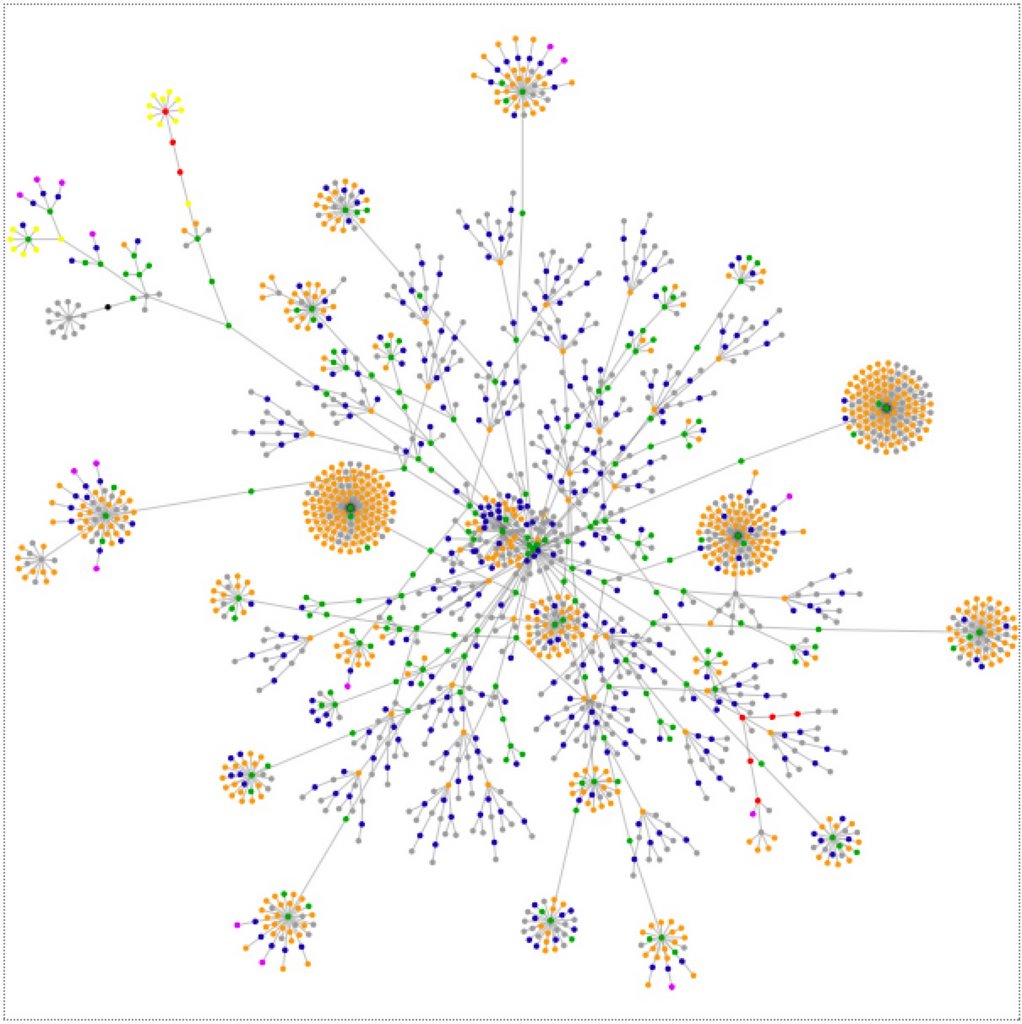
Well, everybody's doing it (doing it, doing it) so I have to. Yes, if everybody else jumped off a cliff I would too, mum. This is what the HTML tags look like for this site when run through the websitesasgraphs Java Applet. It is also what the mental contents of my my brain look like when viewed through any medium at all.I can't believe Pharyngula's was so tidy. Maybe his HTML is cleaner than mine, or maybe he cheated by not including the 6000 year archive from his old site; his brain is certainly no tidier than mine, I warrant...
State religion encroaching on military freedoms to believe
While I'm working through the conceptual tangle I've gotten myself in over microbial species. allow me to mention this item from Mike Dunford's The Questionable Authority: apparently the US Army National Cemetery Administration will not permit Wiccans to use a symbol for the headstones of dead veterans.
Guys, the reason why there's a separation of church and state in the first place is because of just this sort of encroachment. If you aren't of an "approved" religion (and note that despite the present President's prior comments about Wiccans in the military, Wicca is an approved religion in the US military anyway), you get sidelined. Doesn't matter that you gave your life for your nation (or for the policies of the same Administration at least). You can't be remembered as the person that you were.
Religion in public affairs has an inbuilt disposition to encroach upon the freedoms of others, whether they are religious or not. It seems to me this is conveniently overlooked by those of the majority religions when it suits them, and they scream loudly when it harms their own interests, perceived or otherwise, or goals and aims. But one never sees atheism or agnosticism encroaching on religion in a secular society (I think that the Soviet and Maoist communisms were not secular, but a form of state religion). This must be why all those majority Christians claim there is a war on religion, when agmostics, atheists and members of minority religions don't like being subsumed under the ruling majority.
How does a religion even get approval? Is there a Senate standing committee that reviews applications for state approval of religion? I thought that was the sort of thing that the Cold War was notionally about...
Good thing I'm not in the US military (well, actually, there are many reasons why that is a good thing, not least for those who might have had to rely on me in combat). If I died in service I'd want to be buried under a very large question mark. That would be appropriate for an agnostic. Although if I died in combat, I'd probably also want a large exclamation mark too. Not for nothing do compositors call it a "shriek", "screamer", or "bang".
Late note: see this post from Dispatches from the Culture Wars for more background.
Guys, the reason why there's a separation of church and state in the first place is because of just this sort of encroachment. If you aren't of an "approved" religion (and note that despite the present President's prior comments about Wiccans in the military, Wicca is an approved religion in the US military anyway), you get sidelined. Doesn't matter that you gave your life for your nation (or for the policies of the same Administration at least). You can't be remembered as the person that you were.
Religion in public affairs has an inbuilt disposition to encroach upon the freedoms of others, whether they are religious or not. It seems to me this is conveniently overlooked by those of the majority religions when it suits them, and they scream loudly when it harms their own interests, perceived or otherwise, or goals and aims. But one never sees atheism or agnosticism encroaching on religion in a secular society (I think that the Soviet and Maoist communisms were not secular, but a form of state religion). This must be why all those majority Christians claim there is a war on religion, when agmostics, atheists and members of minority religions don't like being subsumed under the ruling majority.
How does a religion even get approval? Is there a Senate standing committee that reviews applications for state approval of religion? I thought that was the sort of thing that the Cold War was notionally about...
Good thing I'm not in the US military (well, actually, there are many reasons why that is a good thing, not least for those who might have had to rely on me in combat). If I died in service I'd want to be buried under a very large question mark. That would be appropriate for an agnostic. Although if I died in combat, I'd probably also want a large exclamation mark too. Not for nothing do compositors call it a "shriek", "screamer", or "bang".
Late note: see this post from Dispatches from the Culture Wars for more background.
Saturday, May 27, 2006
How not to apply evolution to culture
Here is a small piece in the Korea Herald, by Arne Jernelov on how evolution explains cultural excellence. It's all about sexual selection, you see - if you do something that is very hard and very costly, you are attracting mates, and this explains sports, painting, literature and science. It is only coincidental that the author is a scientist (an environmental biochemist). I bet he also plays sport competitively.
Friday, May 26, 2006
Microbial species 4: degrees of sex
When we attempt to apply to organisms that are not obligately sexual (that is, which don't have to have sex to reproduce) concepts that were specified to use with those that are, we have problems. The Recombination Model is one such attempt. Sure, some microbial species exchange genes. Others do it more frequently and more completely. There appears to be a continuum of gene exchange all the way from almost never to almost every time. So why should we expect that gene transfer will provide us with the sort of homogeneity of lineages and quasispecies that it does in obligate sexuals?
In part I believe this is because we always start from what we know. As I mentioned, the existence and ubiquity of asexual organisms has been resisted from a long time, and treated as exceptional rather than the rule, because biology began with large scale plants and animals, where the paradigm cases were encountered for the biospecies concept. As exceptional cases were encountered, these concepts were stretched, and modified, to serve the increasingly "deviant" cases, until now we realise that deviance is relative to the paradigm conceptions rather than a fact about the organisms. What should we say instead?
I believe we should treat this continuum idea more seriously and as the basis from which the metazoan and metaphyte conceptions are drawn out. And we should consider how the two factors of the Templeton conception - exchange and ecological niche - play differing roles according to the degree of sex a lineage has.
Before I deal with this in detail, let me note for the record that there can be, and must certainly often be, other reasons why the carpet is not smooth, but is patchy. Extinction can cause there to be patches in genome space. Some varieties die out. While this can be because of selection, often it will be due to plain old genetic drift, and contingency. A lineage of asexuals can stochastically drift due to random biases in the direction of mutation, for instance, while earlier forms can go extinct simply because of random drift or random termination of that clone. Moreover, if a genome evolves in a habitat that is sensitive to sudden changes in climate or even geological change that degrades it, then that genome and its neighbours will become extinct. Evolution doesn't explore the same coordinates in genome space all the time and everywhere. This is similar to the phylogenetic trends that occur through simple stochasticity, because clonal evolution is phylogeny.

So, back to the notion that sex is not an all-or-nothing affair, so to speak. If the continuum ranges from 0% gene exchange (total asexuality) to 50% gene exchange (total sexuality), then it follows that at the asexual end, exchange can have only limited to no effect on maintaining homogeneity, while at the sexual end, it can have a very great role in maintaining homogeneity. Likewise, at the asexual end, homogeneity not due to stochastic effects will be due largely to ecological selection (fitness peak tracking), while for sexuals this will not be so great a cause. I have given a schematic graph to illustrate this.
This will be why we find that gene exchange doesn't have a simple relationship to genomic homogeneity. It will depend on the rate and amount of genes shared across lineages case by case, as well as the degree to which the quasispecies is maintained by ecological interchangeability. Following on from my discussion about speciation earlier, and my 2001 paper on species concepts, where I employed this evolutionary aspect of the nature of sex to argue that being a species is an evolved trait, not a natural kind, we ought to expect that each species and group of species has its own unique evolutionary history and therefore properties, just as limbs and lungs and livers do. There will be a more general theoretical context of adaptive landscapes, genetic dynamics, and so on, but given that each evolutionary group has encountered different conditions, this means that each modality will be shared in a fairly limited way.
Moreover, this means that biospecies is not the most basal notion of species. In fact, biospecies, or reproductive conceptions of species in general, are derived modalities. The basal notion is quasispecies. All species are at least quasispecies; some are in addition reproductive cohesion or isolation conceptions. This means that some standard requirements for biospecies, such as reciprocal monophyly, do not need to apply to all species. But there is one rather interesting aspect to this approach that I find illuminating, although your mileage may vary: a simple quasispecies is cohered by more or less one adaptive peak (if it is cohered; stochastic clustering does not imply this), while a biospecies famously can be and often is adapted as a generalist or have polytypic traits for differing adaptive peaks.

What maintains a sexual species in this case will be, therefore, the combination of extrinsic selection, and internal or intrinsic cohesion, due to selection for reproductive compatibility with potential mates. I have a paper forthcoming in Biology and Philosophy which argues this in detail. Microbial species will tend to depend on adaptive peak cohesion inversely to the degree that they do share their genes and directly to what functional value of those genes they share have ecologically.
Enough for now. I'll wrap up this series next post.
In part I believe this is because we always start from what we know. As I mentioned, the existence and ubiquity of asexual organisms has been resisted from a long time, and treated as exceptional rather than the rule, because biology began with large scale plants and animals, where the paradigm cases were encountered for the biospecies concept. As exceptional cases were encountered, these concepts were stretched, and modified, to serve the increasingly "deviant" cases, until now we realise that deviance is relative to the paradigm conceptions rather than a fact about the organisms. What should we say instead?
I believe we should treat this continuum idea more seriously and as the basis from which the metazoan and metaphyte conceptions are drawn out. And we should consider how the two factors of the Templeton conception - exchange and ecological niche - play differing roles according to the degree of sex a lineage has.
Before I deal with this in detail, let me note for the record that there can be, and must certainly often be, other reasons why the carpet is not smooth, but is patchy. Extinction can cause there to be patches in genome space. Some varieties die out. While this can be because of selection, often it will be due to plain old genetic drift, and contingency. A lineage of asexuals can stochastically drift due to random biases in the direction of mutation, for instance, while earlier forms can go extinct simply because of random drift or random termination of that clone. Moreover, if a genome evolves in a habitat that is sensitive to sudden changes in climate or even geological change that degrades it, then that genome and its neighbours will become extinct. Evolution doesn't explore the same coordinates in genome space all the time and everywhere. This is similar to the phylogenetic trends that occur through simple stochasticity, because clonal evolution is phylogeny.

So, back to the notion that sex is not an all-or-nothing affair, so to speak. If the continuum ranges from 0% gene exchange (total asexuality) to 50% gene exchange (total sexuality), then it follows that at the asexual end, exchange can have only limited to no effect on maintaining homogeneity, while at the sexual end, it can have a very great role in maintaining homogeneity. Likewise, at the asexual end, homogeneity not due to stochastic effects will be due largely to ecological selection (fitness peak tracking), while for sexuals this will not be so great a cause. I have given a schematic graph to illustrate this.
This will be why we find that gene exchange doesn't have a simple relationship to genomic homogeneity. It will depend on the rate and amount of genes shared across lineages case by case, as well as the degree to which the quasispecies is maintained by ecological interchangeability. Following on from my discussion about speciation earlier, and my 2001 paper on species concepts, where I employed this evolutionary aspect of the nature of sex to argue that being a species is an evolved trait, not a natural kind, we ought to expect that each species and group of species has its own unique evolutionary history and therefore properties, just as limbs and lungs and livers do. There will be a more general theoretical context of adaptive landscapes, genetic dynamics, and so on, but given that each evolutionary group has encountered different conditions, this means that each modality will be shared in a fairly limited way.
Moreover, this means that biospecies is not the most basal notion of species. In fact, biospecies, or reproductive conceptions of species in general, are derived modalities. The basal notion is quasispecies. All species are at least quasispecies; some are in addition reproductive cohesion or isolation conceptions. This means that some standard requirements for biospecies, such as reciprocal monophyly, do not need to apply to all species. But there is one rather interesting aspect to this approach that I find illuminating, although your mileage may vary: a simple quasispecies is cohered by more or less one adaptive peak (if it is cohered; stochastic clustering does not imply this), while a biospecies famously can be and often is adapted as a generalist or have polytypic traits for differing adaptive peaks.

What maintains a sexual species in this case will be, therefore, the combination of extrinsic selection, and internal or intrinsic cohesion, due to selection for reproductive compatibility with potential mates. I have a paper forthcoming in Biology and Philosophy which argues this in detail. Microbial species will tend to depend on adaptive peak cohesion inversely to the degree that they do share their genes and directly to what functional value of those genes they share have ecologically.
Enough for now. I'll wrap up this series next post.
Microbial species 3: Quasispecies and ecology

The second main approach to a natural conception of microbial species (by which I mean, as opposed to operational, practical or conventional ones, collectively called "artificial" conceptions) is what I will call the Quasispecies Model. According to the concept developed by Manfred Eigen for viral species, a quasispecies ("as-if-species") is a cluster of genomes in a genome space of the dimensionality the number of loci. A quasipecies is in effect a cloud of genomes, with a "wild-type" coordinate (that is, genome) that may or may not actually have an extant or extinct instance.
A genetic cluster of the quasispecies kind is therefore not unlike James Mallet's Genotypic Cluster Concept (1995), although this is primarily an operational definition than a substantive underlying account of species. We still need to account for quasispecies existing in the first place. We have considered one possible mechanism - gene sharing by lateral transfer - and found it to be insufficient. Is there something else we might make use of?

There is one proposal by Alan Templeton (1989), devised for sexual organisms, which defines a species as a genetic cluster, as Mallet's does, but accounts for it either by genetic exchange, as in the recombination model, or ecological interchangeability. This latter notion is what we might call the "Fitness Peak Conception" of quasispecies.
Each coordinate in genome space, that is to say each genome, has a fitness value associated with it that is imposed by ecological factors. If the adaptive landscape is relatively smooth, which means that adjacent coordinates are correlated in their fitness values, we should expect in the absence of all other causes of clustering that the cloud of genomes will tend to centre upon the most adaptive genome. Of course, this is an abstraction and a gross simplification - genomes are not independent of each other, or from fitness values. Organisms create their ecological conditions to a degree, and how fit a genome is depends also upon what other genomes exist in a population (at least, in sexual organisms), but we can leave these complications to one side for the moment.
So one potential reason why quasispecies exist, why genomes cluster, is that they track local fitness peaks. Let's flesh this out, so to speak. Take a pathogen that is clonal. It needs to employ certain features of the host species in order to infect and exploit that host. Assuming these don't change - say they are recognition molecules on a cell surface - the quasispecies will cluster about those point in the genome space that are more effective than others with respect to the capacity to infect and exploit.
So now we have the two cohesion mechanisms proposed by Templeton - cohesion due to shared genes, and cohesion due to the need to exploit the environment better than competitors. Anything that can do well at the latter will tend to be better represented in the average population. Hence quasispecies.
But fitness peaks typically do not remain constant or decoupled from the populational structure, as I said. Does this mean that quasispecies are not real species because they are ephemeral? Of course not - all species are, over a suitably extended timescale, ephemeral. That is in the nature of evolution. What the fitness peak conception means is that a quasispecies will remain homogeneous so long as there is a more or less unitary fitness peak. If the peaks shift, there will be "speciation". Oh heck, let's stop the pretense that quasispecies aren't real species. There will be real speciation.
In the next blog, I will discuss a way to bring these two notions together, and to link quasispecies with biospecies (sexual species).
Eigen, Manfred (1993), "The origin of genetic information: viruses as models", Gene 135 (1-2):37–47.
——— (1993), "Viral quasispecies", Scientific American July 1993 (32-39).
Mallet, J (1995), "The species definition for the modern synthesis", Trends in Ecology and Evolution 10 (7):294-299.
Templeton, Alan R. (1989), "The meaning of species and speciation: A genetic perspective", in D Otte and JA Endler (eds.), Speciation and its consequences, Sunderland, MA: Sinauer, 3-27.
Thursday, May 25, 2006
Microbial species 2: recombination
The cluster of genomes of asexual organisms forms what is called a "phylotype" (Denniston 1974, a term coined by C. W. Cotterman in unpublished notes dated 1960; I like to track these things down). Phylotype is a taxon-neutral term, though, that is determined entirely by the arbitrary level of genetic identity chosen. For example, "species" in asexuals might be specified as being 98%+ similarity of genome, or it might be 99.9%+ (I have seen both in the literature). A phylotype of, say 67% or 80% might be used for other purposes (such as identifying a disease-causing group of microbes).
The phylotype concept, while useful in other respects, reinvents (or preinvents - 1960 predates the work of Sokal and Sneath) phenetics. A phenetic taxon was called the Operational Taxonomic Unit (OTU) and it used an arbitrary measure of similarity and difference: an 80% "phenon line" was the arbitrary measure for species based on phenotypic similarities. The problem was that the distances changes as you chose different principal components, and I warrant the same is true for phylotypes.
One solution to the Problem of Homogeneity for asexuals is what I will call the Recombination Species Concept. Proposed by Dykhuizen and Green in 1991, it basically the Biological Species Concept for lineages that occasionally share genes or gene fragments through lateral transfer.
There are several mechanisms by which lateral transfer of DNA can occur among "prokaryotes". One is DNA fragment reuptake, in which DNA from a cell that has lysed (its membrane or wall has disintegrated, releasing the cell contents into the medium) is taken up by another cell, and rather than being digested it becomes active. There are variations on this. Entire chromosomal rings, called plasmids can be taken up this way. Or a cell can "bleb", forming vesicles or compartments of lipids, containing DNA (including plasmids), which then attach to the receiving cell, opening up to the interior.
I mentioned prokaryotes before. This refers broadly to a paraphyletic group of organisms that are basically not-eukaryotes. Nowadays we refer instead to several groups: Bacteria, Archaea (which is sometimes decomposed into several other groups), and Eukaryota. One thing the not-Eukaryotes have in common, though, is a lack of a nuclear membrane, allowing the transfer of genetic material between genomes.

So the Recombination model of microbial species is based on the claim that the greater the genetic distance between strains, the less likely it is that the genes will be functional and useful in the receiving strain, and this is what serves to maintain the homogeneity of bacterial and other microbial species. One of the claims is in fact that the differences in genetic structure, and in some cases differences in restriction enzymes, that break DNA sequences, will make a nonsense of the DNA fragment or insert it in a nonfunctional location in the target genome.
These compatibility issues act like sex does to maintain the overall "location" in genome space of the population. Those strains that deviate too far from the mode will be unable to take up the functionally useful lateral genes, and so will be more susceptible to extinction through genetic load.
So the Recombination model is a mix of Maynard Smith's theory of sex, and Mayr's notion of biological species. The only problem is that it isn't consistently true. A beautiful explanation is spoiled by ugly facts. Recombination via lateral transfer appears to be rather more profligate than first appeared (Beiko, et al. 2005), and there are some "species" of bacteria, such as the Lyme Disease-causing spirochete Borrelia burgdorferi, that appear not to share genes much, if at all (as Dykhuizen himself observes, Dykhuizen and Baranton 2001). So if in those cases clustering occurs, it is not due to lateral transfer, but some other processes.
I failed to mention a process that is directly analogous to sex in bacteria - conjugation. This is a case where part of the genetic component, usually plasmids, which are secondary small chromosomes (B), or the main nucleoid (A), can be inserted into another cell via processes called pili, which are part of the Type IV secretory system used for other purposes and which is homologous to flagella. The typical mode of conjugation is that one mating type (often called the "male") is activated by pheromones from another mating type ("female") to attach the pilus to the recipent, and insert the genetic material.
Now this is "almost-sex", because there is no genetic reassortment, but other processes will tend to shuffle genes into the nucleoid, as well as utilising the taken-up plasmids. But again, while the mating types seem to act as cohesive mechanisms, conjugation can be profilgate across large, even vast, phylogenetic distances (and hence genetic distances). It has been observed between bacteria and yeast, bacteria and plants, and there has even been a case in which it was observed between bacteria (E. coli) and mammalian (hamster) cells (Waters 2001).
So while it may be that recombination of lineages through partial genetic transfer operates as a reason for some phylotypes, it does not account for all, and is therefore not a sine qua non of specieshood, or homogeneity, among microbes.
Next, we'll consider ecological accounts, as well as drift, migration and geographical isolation.
Beiko, Robert G., Timothy J. Harlow, and Mark A. Ragan (2005), "Highways of gene sharing in prokaryotes", Proceedings of the National Academy of Sciences, USA 102 (40):14332-14337.
Denniston, Carter (1974), "An extension of the probability approach to genetic relationships: One locus", Theoretical Population Biology 6 (1):58-75.
Dykhuizen, D. E., and G. Baranton (2001), "The implications of a low rate of horizontal transfer in Borrelia", Trends in Microbiology 9 (7):344-350.
Dykhuizen, D. E., and L. Green (1991), "Recombination in Escherichia coli and the definition of biological species", Journal of Bacteriology 173 (22):7257-7268.
Waters, V. L. (2001), "Conjugation between bacterial and mammalian cells", Nature Genetics 29 (4):375-376.
The phylotype concept, while useful in other respects, reinvents (or preinvents - 1960 predates the work of Sokal and Sneath) phenetics. A phenetic taxon was called the Operational Taxonomic Unit (OTU) and it used an arbitrary measure of similarity and difference: an 80% "phenon line" was the arbitrary measure for species based on phenotypic similarities. The problem was that the distances changes as you chose different principal components, and I warrant the same is true for phylotypes.
One solution to the Problem of Homogeneity for asexuals is what I will call the Recombination Species Concept. Proposed by Dykhuizen and Green in 1991, it basically the Biological Species Concept for lineages that occasionally share genes or gene fragments through lateral transfer.
There are several mechanisms by which lateral transfer of DNA can occur among "prokaryotes". One is DNA fragment reuptake, in which DNA from a cell that has lysed (its membrane or wall has disintegrated, releasing the cell contents into the medium) is taken up by another cell, and rather than being digested it becomes active. There are variations on this. Entire chromosomal rings, called plasmids can be taken up this way. Or a cell can "bleb", forming vesicles or compartments of lipids, containing DNA (including plasmids), which then attach to the receiving cell, opening up to the interior.
I mentioned prokaryotes before. This refers broadly to a paraphyletic group of organisms that are basically not-eukaryotes. Nowadays we refer instead to several groups: Bacteria, Archaea (which is sometimes decomposed into several other groups), and Eukaryota. One thing the not-Eukaryotes have in common, though, is a lack of a nuclear membrane, allowing the transfer of genetic material between genomes.
So the Recombination model of microbial species is based on the claim that the greater the genetic distance between strains, the less likely it is that the genes will be functional and useful in the receiving strain, and this is what serves to maintain the homogeneity of bacterial and other microbial species. One of the claims is in fact that the differences in genetic structure, and in some cases differences in restriction enzymes, that break DNA sequences, will make a nonsense of the DNA fragment or insert it in a nonfunctional location in the target genome.
These compatibility issues act like sex does to maintain the overall "location" in genome space of the population. Those strains that deviate too far from the mode will be unable to take up the functionally useful lateral genes, and so will be more susceptible to extinction through genetic load.
So the Recombination model is a mix of Maynard Smith's theory of sex, and Mayr's notion of biological species. The only problem is that it isn't consistently true. A beautiful explanation is spoiled by ugly facts. Recombination via lateral transfer appears to be rather more profligate than first appeared (Beiko, et al. 2005), and there are some "species" of bacteria, such as the Lyme Disease-causing spirochete Borrelia burgdorferi, that appear not to share genes much, if at all (as Dykhuizen himself observes, Dykhuizen and Baranton 2001). So if in those cases clustering occurs, it is not due to lateral transfer, but some other processes.
I failed to mention a process that is directly analogous to sex in bacteria - conjugation. This is a case where part of the genetic component, usually plasmids, which are secondary small chromosomes (B), or the main nucleoid (A), can be inserted into another cell via processes called pili, which are part of the Type IV secretory system used for other purposes and which is homologous to flagella. The typical mode of conjugation is that one mating type (often called the "male") is activated by pheromones from another mating type ("female") to attach the pilus to the recipent, and insert the genetic material.Now this is "almost-sex", because there is no genetic reassortment, but other processes will tend to shuffle genes into the nucleoid, as well as utilising the taken-up plasmids. But again, while the mating types seem to act as cohesive mechanisms, conjugation can be profilgate across large, even vast, phylogenetic distances (and hence genetic distances). It has been observed between bacteria and yeast, bacteria and plants, and there has even been a case in which it was observed between bacteria (E. coli) and mammalian (hamster) cells (Waters 2001).
So while it may be that recombination of lineages through partial genetic transfer operates as a reason for some phylotypes, it does not account for all, and is therefore not a sine qua non of specieshood, or homogeneity, among microbes.
Next, we'll consider ecological accounts, as well as drift, migration and geographical isolation.
Beiko, Robert G., Timothy J. Harlow, and Mark A. Ragan (2005), "Highways of gene sharing in prokaryotes", Proceedings of the National Academy of Sciences, USA 102 (40):14332-14337.
Denniston, Carter (1974), "An extension of the probability approach to genetic relationships: One locus", Theoretical Population Biology 6 (1):58-75.
Dykhuizen, D. E., and G. Baranton (2001), "The implications of a low rate of horizontal transfer in Borrelia", Trends in Microbiology 9 (7):344-350.
Dykhuizen, D. E., and L. Green (1991), "Recombination in Escherichia coli and the definition of biological species", Journal of Bacteriology 173 (22):7257-7268.
Waters, V. L. (2001), "Conjugation between bacterial and mammalian cells", Nature Genetics 29 (4):375-376.
Wednesday, May 24, 2006
On microbial species
OK, this is one of a series of posts in which I will play with ideas that might become a paper.
The problem is this: usually we define a species as a group of related organisms that share genes (or a gene pool, which amounts to the same thing). Sometimes we include also ecological considerations (either in the form of natural selection, or in terms of sharing a niche).
But many microbial species either do not share genes to reproduce, or they can but do not need to. So, the question is sometimes raised whether microbes (of this kind) form species at all, or if there is some replacement term or concept for microbial taxonomy.
Historically, it took a long time to even accept that there were asexual organisms. Darwin discussed hermaphroditic species, but they still had mating types or genders; it was just that a single individual had both kinds. It was long recognised that some plants could propagate vegetatively. But the notion that there were obligately asexual organisms was doubted, for instance, by Fisher as late as 1958 (in the second edition of the Genetical Theory of Natural Selection). George Gaylord Simpson, the famous joint architect of the synthesis and paleontologist, simply denied that asexuals formed species. Call them something else, he said.
But bacteriologists, mycologists, and virologists all continued to name and describe species, even though they could not really make use of the Biological Species Concept of Dobzhansky and Mayr. They relied on their staining properties, the colony shape, the microscopic morphology of the cells, and of course the ecological conditions under which they lived. There was lacking, though, a clear definition of what a species could be for these organisms.
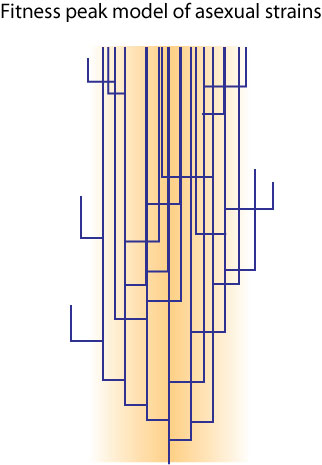
Part of the problem is this: if a species were obligately clonal, then each mutation would make a new clonal lineage:

and we would expect to find not clusters but a carpet of strains more or less evenly distributed. How can we account for this? I will call this the Problem of Homogeneity: why are asexual lineages ever found as groups at all? Why are they homogeneous over time, and stable enough to be called "species"?
I will follow this up in the next post, but I want to get your feedback first.
The problem is this: usually we define a species as a group of related organisms that share genes (or a gene pool, which amounts to the same thing). Sometimes we include also ecological considerations (either in the form of natural selection, or in terms of sharing a niche).
But many microbial species either do not share genes to reproduce, or they can but do not need to. So, the question is sometimes raised whether microbes (of this kind) form species at all, or if there is some replacement term or concept for microbial taxonomy.
Historically, it took a long time to even accept that there were asexual organisms. Darwin discussed hermaphroditic species, but they still had mating types or genders; it was just that a single individual had both kinds. It was long recognised that some plants could propagate vegetatively. But the notion that there were obligately asexual organisms was doubted, for instance, by Fisher as late as 1958 (in the second edition of the Genetical Theory of Natural Selection). George Gaylord Simpson, the famous joint architect of the synthesis and paleontologist, simply denied that asexuals formed species. Call them something else, he said.
But bacteriologists, mycologists, and virologists all continued to name and describe species, even though they could not really make use of the Biological Species Concept of Dobzhansky and Mayr. They relied on their staining properties, the colony shape, the microscopic morphology of the cells, and of course the ecological conditions under which they lived. There was lacking, though, a clear definition of what a species could be for these organisms.
Part of the problem is this: if a species were obligately clonal, then each mutation would make a new clonal lineage:

and we would expect to find not clusters but a carpet of strains more or less evenly distributed. How can we account for this? I will call this the Problem of Homogeneity: why are asexual lineages ever found as groups at all? Why are they homogeneous over time, and stable enough to be called "species"?
I will follow this up in the next post, but I want to get your feedback first.
Monday, May 22, 2006
What, if anything, is a rabbit?
Darren Naish [via Pharyngula] has a lovely article about the morphology and taxonomic and phylogenetic relationships of Lagomorpha, rabbits and hares. In the course of the piece, Naish quotes one Albert Wood, from 1957, whose paper with the title of this post starts out
The title of this paper is slightly modified from that of an article I encountered some years ago, which appeared to be approaching the problem of the relationships of the Lagomorpha, or rabbits and their relatives, from the most basic point of view. This paper, entitled “Gibt es Leporiden?”, seemed to be questioning the very existence of such animals. Investigation showed, however, that the question involved was not whether members of the family Leporidae existed, but whether rabbit-hare hybrids did. Since then, I have met no one who questions the existence of rabbits and hares, and I have been reluctantly forced to accept them.They don't write papers like that any more. I, too, question the reality of rabbits. Just because.
Sunday, May 21, 2006
Islamist paradise: selling children
The Times is reporting that 20 young boys were bought from an Islamist leader, Gud Khan, in Pakistan, who runs a "pure Islamic environment" at a centre initially funded by al-Qaeda, by Osama bin Laden directly. The sale was made to a Christian missionary who was freeing them and returning them to their parents, from whom they had been kidnapped. Khan apparently knows that the children will be used for sexual and illegal activities, and doesn't care, because they are Christian. The proceeds are used to support his Islamic paradise, free from the corruption and degradation of the West. Oh irony!
The obvious inference to draw here is correct but insufficient. Islamism is not based on some morally pure foundation. It is political, pure and simple. Sure, this is true, but a much better inference is that religion makes for a very bad foundation for morality. Not only Islamists, but Christians, Jews, Hindus and every other religious movement, privileges believers over unbelievers morally. It's OK to kill abortionists or gays, to disenfranchise Jews or Arabs, and so on, because They Aren't The Same As Us.
And Christians in the US and here (Australia, in case you forgot) will often criticise those who think that all human beings deserve the same rights and privileges in society as "humanists". In fact, humanism has become the all-purpose bogey among religious circles. Of course it is - it undercuts the basic moral intuition of all religions: that rights are given based on conformity to their, and only their, standards of behaviour.
I am proud to be a humanist. I think that Jews, Muslims, Hindus, Catholics, Scientologists and even those evil atheists (spelled athiest by fundamentalists) have exactly the same rights as any other person. That means they can run for office, vote as they wish, take any course of action even if it contravenes the "deeply held moral standards" of some religious majority so long as it is not illegal, and live wherever they like. This is a measure of civilisation. The covert prejudices and bigotry of religion need to be opposed openly by a civilised state.
To my religious friends, who are not at all like this, most of the time, I can only say that your morality is civilised in spite of, not because of, your religious traditions. It was but an eye blink since your own traditions, if they are enlightened now, were treating those who differed as subhuman. Christians, Muslims, Jews, it doesn't matter. The underlying social function of religion is to exclude, not include. Thus it ever has been.
Humanism is not a religion. It is a general principle - that human life is equally valid no matter the social status, ethnicity, religious belief, or sexual orientation of the individual. Somebody should found a country on these principles...
The obvious inference to draw here is correct but insufficient. Islamism is not based on some morally pure foundation. It is political, pure and simple. Sure, this is true, but a much better inference is that religion makes for a very bad foundation for morality. Not only Islamists, but Christians, Jews, Hindus and every other religious movement, privileges believers over unbelievers morally. It's OK to kill abortionists or gays, to disenfranchise Jews or Arabs, and so on, because They Aren't The Same As Us.
And Christians in the US and here (Australia, in case you forgot) will often criticise those who think that all human beings deserve the same rights and privileges in society as "humanists". In fact, humanism has become the all-purpose bogey among religious circles. Of course it is - it undercuts the basic moral intuition of all religions: that rights are given based on conformity to their, and only their, standards of behaviour.
I am proud to be a humanist. I think that Jews, Muslims, Hindus, Catholics, Scientologists and even those evil atheists (spelled athiest by fundamentalists) have exactly the same rights as any other person. That means they can run for office, vote as they wish, take any course of action even if it contravenes the "deeply held moral standards" of some religious majority so long as it is not illegal, and live wherever they like. This is a measure of civilisation. The covert prejudices and bigotry of religion need to be opposed openly by a civilised state.
To my religious friends, who are not at all like this, most of the time, I can only say that your morality is civilised in spite of, not because of, your religious traditions. It was but an eye blink since your own traditions, if they are enlightened now, were treating those who differed as subhuman. Christians, Muslims, Jews, it doesn't matter. The underlying social function of religion is to exclude, not include. Thus it ever has been.
Humanism is not a religion. It is a general principle - that human life is equally valid no matter the social status, ethnicity, religious belief, or sexual orientation of the individual. Somebody should found a country on these principles...
Friday, May 19, 2006
Ian McKellen - bigger than Jesus?
Famously, the Beatles lost a lot of customers when John Lennon said that they (the group) were "bigger than Jesus" (meaning they had more fans than Jesus did at that particular moment). British litotes and irony failed to register with Americans, and so there were the famous LP burnings (and damn, aren't the people who kept their original LPs in good order happier now).
Ian McKellen nearly got himself into similar hot water just recently in this interview. From beginning a sentence with "The Bible ought to have a disclaimer that it is fiction" he got to "it takes an act of faith" - great save! Every so often the rest of the English-speaking world has to realise there are gaps in the rhetorical education of Americans...
[From the commenter cm on Pharyngula]
Ian McKellen nearly got himself into similar hot water just recently in this interview. From beginning a sentence with "The Bible ought to have a disclaimer that it is fiction" he got to "it takes an act of faith" - great save! Every so often the rest of the English-speaking world has to realise there are gaps in the rhetorical education of Americans...
[From the commenter cm on Pharyngula]
Sorry for the silence, and chimp hybrids
I apologise for the lack of posts. My hindbrain (Powerbook G4 12") was out being serviced, and I (i) was stuck on a PC (*shudder* How do people work on those things?), and (ii) I got busy with other stuff, which may find its way here anyway.
So while I was incommunicado (is anyone ever communicado?) the "news" that humans and chimps were hybridising for several millions of years appeared in the New York Times, presaging an article in Nature. John Hawks has a nice takedown of this paper, although it has been hysterically dealt with by the media.
But what's the big deal? Hybrids occur between greatly differentiated lineages all the time. They aren't, though, common, and while many are sterile like the mule, many are also fertile and can back-breed into one of the parent species. Hawks mentions the lion-tiger crosses in genus Panthera, the tigon and the liger, which are fertile and not, respectively. Tigers (nine species or subspecies) and lions separated about 2 million years ago. Similarly, horse evolution has allowed a considerable amount of cross breeding between species that separated about 4 to 2 million years ago. When such things occur, the resulting process of genes crossing species boundaries is called introgression, and it is more common than we might think.
So why would the discovery, if it is, that genes occasionally cross from chimp to hominid lineages be any more unusual than the horse or Panthera hybrids? Obviously because we are involved. Our evolution is, after all, just ordinary evolution, no matter how unusual our brain size or other phenotypic traits. All species are unique (which is why we call them "species"). And the rate of introgression looks to be pretty rare anyway. It's not like Greatn Grandfather was out for a bit of chimp tail every Saturday night.
Now, some housekeeping. In the near future I will be travelling a fair bit, so I'll be reviving some old posts from the dusty archives. Moreover, this blog is moving. Stay tuned for an announcement. I'll leave this site up indefinitely, but you'll need to revise your RSS feeds and bookmarks when it does.
So while I was incommunicado (is anyone ever communicado?) the "news" that humans and chimps were hybridising for several millions of years appeared in the New York Times, presaging an article in Nature. John Hawks has a nice takedown of this paper, although it has been hysterically dealt with by the media.
But what's the big deal? Hybrids occur between greatly differentiated lineages all the time. They aren't, though, common, and while many are sterile like the mule, many are also fertile and can back-breed into one of the parent species. Hawks mentions the lion-tiger crosses in genus Panthera, the tigon and the liger, which are fertile and not, respectively. Tigers (nine species or subspecies) and lions separated about 2 million years ago. Similarly, horse evolution has allowed a considerable amount of cross breeding between species that separated about 4 to 2 million years ago. When such things occur, the resulting process of genes crossing species boundaries is called introgression, and it is more common than we might think.
So why would the discovery, if it is, that genes occasionally cross from chimp to hominid lineages be any more unusual than the horse or Panthera hybrids? Obviously because we are involved. Our evolution is, after all, just ordinary evolution, no matter how unusual our brain size or other phenotypic traits. All species are unique (which is why we call them "species"). And the rate of introgression looks to be pretty rare anyway. It's not like Greatn Grandfather was out for a bit of chimp tail every Saturday night.
Now, some housekeeping. In the near future I will be travelling a fair bit, so I'll be reviving some old posts from the dusty archives. Moreover, this blog is moving. Stay tuned for an announcement. I'll leave this site up indefinitely, but you'll need to revise your RSS feeds and bookmarks when it does.
Monday, May 15, 2006
A guide to Christianity, for sports fans
Via Uncertain Principles via Jim Henley, at last a guide to terms and types of Christianity for those whose idea of an education is reading the Sports Page. In particular, I find the description of fundamentalism enlightening:
Fundamentalism
The belief that basic elements of play - like passing, ball handling, and defense - are the essential building blocks of a winning basketball team is generally referred to as "fundamentalism." The fundamentalists formulated their doctrine in the 1980s against the showy, heretical play of Magic Johnson's Los Angeles Lakers. Leading fundamentalist institutions include Bob Jones University and Syracuse. Larry Brown's failure to get the Knicks into the playoffs has been seen as a major setback for the cause of fundamentalism.
A question to my readers
Folks, I've been invited to join the Seed Magazine Science Blog site that Pharyngula, Aetiology, Evolgen, Stranger Fruit and others have joined. If it's good enough for PZ Variablename, it has to be good enough for me. But I wonder how this might affect the fifteen readers who aren't part of my family. So please, let me know what you think. Should I? Or shouldn't I?
Later: Well the ayes have it. Once I get things sorted out with Seed, we'll start there. I'll leave this blog up indefinitely, but I'll probably intersperse new posts with old ones for a while. Thanks guys. I had no idea my mother paid so many people to read this blog...
Saturday, May 13, 2006
Evolution and truth
One of the problems in having a philosophy related blog is that ideas are hard things to generate on demand, so often you need someone to raise the problems for you to think about. Being naturally (and preternaturally!) lazy, I don't go out looking for problems (of a philosophical nature; the ordinary kind seem to find me like flies find rotting garbage). Hence, this blog is sporadic.
Well, I just tripped over an interesting question raised by Certain Doubts: can we reconcile the Platonic value of truth with an evolutionary view of epistemology? That is, if we think that our knowledge is the outcome of evolution (which I do), can we still think that knowledge is about the getting of truth? Absolute truth, that is, not the purely "good enough for government work" kind that we all rely upon in daily life.
The conundrum is this: evolution (natural selection, anyway) serves only to optimise that which is satisfactory to the past environments of the organism's ancestors. To use a memorable phrase of Hull's, evolution is like the Prussian military academy that turns out officers admirably suited to winning past wars. But our cognitive capacities were not designed to deal with such matters as subatomic physics, comparative biology, or risk analysis in complex economic systems. We were designed to deal with living in certain environments and social groupings that we no longer mostly live in, and the ideal of truth-gathering is well out of that environment. In short, can we trust modified monkey brains, as Darwin posed in another context?
One way to rescue some form of naturalised epistemology f this kind might be to say that we can rely upon our native cognition in cases where they are closely similar to those ancestral conditions, whatever they might have been. But even this fails, since evolution is not, generally speaking, a global optimiser, but a general satisficer. That is, so long as the animal is viable enough, relative to other candidates, then it will procreate its kinds. Some sort of induction is good enough for hominids in their usual environment - as Quine said, "Creatures inveterately wrong in their inductions have a pathetic, but praiseworthy, tendency to die before reproducing their kind". I don't know about the praiseworthiness, which remains to be seen, but Quine's claim was that we have an innate "quality space" honed by selection, which refers because it works.
There's an obvious problem with this, or rather, several obvious problems. First of all, we often make mistakes. The problems of optical illusions have a long history in philosophy of indicating the unreliability of vision, and similar issues arise with our cognition. We are very bad at deductive reasoning, for example, when the variables are abstract or unnatural, as the Wason test shows. We are bad at risk assessment - people are afraid of flying but not of riding in a car, although you have a much higher danger of death or injury in cars than planes. We fear home invaders far more than family, although you are more likely to be attacked by a family member than a stranger, and so on. Our cognitive skills are based on whether or not they contribute to reproduction rather than individual knowledge. Evolution, if we envisage it as a designer, cares nothing for truth, just progeny.
Another problem is that our quality spaces are, if they exist from evolution, very domain specific. While it explains why we have a priori concepts - Kant's synthetic a prioria are evolutionary a posterioria, as Lorenz said - it doesn't guarantee their applicability outside those domains. A third problem is the one of satisfaction; if a concept works most of the time, it doesn't make it reliable all the time, just satisfactory so far. Consider what will be better - the ability to spot a predator if and only if there is a predator, or a jumpiness that works most of the time if there is a predator, but also makes us jump at sudden noises and shadows. There is a cognitive cost to being right all the time, and evolution won't burden us with an expensive solution that in any case would take time to employ, while the leopard is leaping at your throat. Better to startle and run, and be embarrassed, than to be right and dead.
So, can we have absolute truth and natural evolved cognition? I think, as Putnam said, that evolutionary epistemology fails to explain the core problems of epistemology. Or does it?
We often focus on individual cognition as the locus of selection, and in one way this is right, because we are considering the reason we have big brains, and the cognitive apparatus they make possible. But there is another level of analysis - that of the tradition or culture. These, too, evolve, only not biologically but culturally. A society that learns how to use local resources to flourish has knowledge even if the "explanations" given involve ritual magic or religious etiology. It doesn't matter how the efficacy of Amazonian poisons derived from frogs is explained by the local tribes - it matters that the tribes know that it works.
But that brings with it implications of the magical explanations, and so on, which are formed largely in the context not of the physical world as such, but the social world in which explanations asked and offered play functional roles in establishing and maintaining social structure. In short, these explanations are not about adapting to the "world" but to "society". And throughout human history, such cultural evolution has been both minimally adaptive in a given environment (or not, as in the Anasazi case where they overexploited local resources), allowing the society to remain viable, and adaptive in social functional terms allowing agents within the culture to interact in various ways. What it does not do is offer truth, or if it does, this is a truth of pragmatic virtue and convention.
But around 1700 or so, a movement finally took off in which several factors combined to permit human cognition to overcome the limitations of biology and society to an extent. In this movement, specialisation ensured that the explanations given were satisfactory in each domain to those who were best acquainted with the material. It recorded the work in detail, and made a virtue of discovery and theory. I am talking about science, of course.
The prior commitment to Platonic or Aristotelian truth had, in 2000 years, made almost no progress of any real kind. While the logical and theological domains were transformed, actual knowledge of the extra-social world was thin on the ground. When advances were made that did relate to physical facts, such as engineering and manufacturing technologies, before this point, they could easily be lost because that knowledge was held only by a small family tradition or a guild that might be banned or become uneconomic at any time. Yes, truth was a virtue, but one more honoured in the breech than the observance.
It wasn't even enough to be empirical. Many, such as Roger Bacon, Nicholas Oresme, Frederick II, and others had done good empirical observation in the middle ages, but the habit didn't take. With the appearance (in fact the evolution) of specialisation and above all communication of results and the availability of the records to all, science took on the role of cognitive system. Subsequent adaptation of scientific institutions made it more able to generate knowledge than at any time in human existence.
But what is science adapting to, exactly? A naive answer might be that it is adapting to the data. This is a nice simple answer - we can rely upon science because hypotheses are tested and proven (in the Old English sense of "proven", meaning well tested and found reliable, as in the "exception that proves the rule" by testing it). Add a dash of falsificationism, and you are on your way. I think this is grossly mistaken.
Science is adapting to the real world, in some manner. It might help to think of it like this - a model builder invites you to guess what he has made, but it has a sheet of some thickness over it. You can see the points that support the sheet well enough, but the identifying details are hidden behind the cover. How can you find out what it is? You have a stick to poke it with, and ten seconds. Go...
Well, it's a large model, and in ten seconds you can't feel all of it, so you poke at the supported bits in the hope that the shape will become clear. At the end of ten seconds, you guess that it's a model of some guttering. It's actually the Vallis Marinaris on Mars.
Science, like you, has a limit on what it can measure, and there's a a cost to that activity, so some conceptual triage is needed. If something is measured, then within measurement error you have knowledge of that data point alone. The rest is inference, interpolation and generalisation. How do you choose what to measure, and what to infer? Some of these choices are influenced by your personal dispositions and predilections, some by the conventions of the discipline. Others are mostly due to social context, government policies, religious beliefs, and so on. Science has some social functional adaptation after all.
This has led some to claim that science is just another worldview, a claim seized upon by antiscience movements like creationism and intelligent designism. But it isn't. Is is not just another worldview. It is an enterprise that is parallel to worldviews, creates worldviews, and shares a multiplicity of disparate worldviews amongst its practitioners. Worldviews aren't what makes science special.
What makes it special is that the institutions themselves tend to make claims that can be challenged and do get challenged, if there is any reason to. And given that the resources of science as limited like any other, there is always reason to do so. Of course, not everything gets tested in the usual sense, but there is sufficient selection for consonance with prior work, for empirical adequacy, for explanatory power and the ability to generate research programs, that in the medium to longer term, science generates pretty adapted results. Adapted to the empirical world, that is.
I can think of some constraints on science, though. One is, and I haven't seen this discussed anywhere so You Heard It Here First™ unless you didn't, that science cannot progress beyond the ability to teach the next generation how to proceed. If something requires a depth of study that is going to take fifty years to learn, it will be abandoned in favour of either some other more rapid payoff to the individual's career, or the field will be divided into more manageable chunks. What can't be, won't be investigated at all.
So science is not absolute truth. Is it truth at all? Are we being objective here? Who knows? But a truth that is unattainable is not a truth that does much hard work. If the truth we can get through science works enough, that's the best we can hope for. Fortunately we got sufficient of a leg up from evolution to get started, and fortunately we did get started. But the Platonic ideal of truth is a dream of a reality we will never get access to, and is thus an item of religious faith not needed.
Well, I just tripped over an interesting question raised by Certain Doubts: can we reconcile the Platonic value of truth with an evolutionary view of epistemology? That is, if we think that our knowledge is the outcome of evolution (which I do), can we still think that knowledge is about the getting of truth? Absolute truth, that is, not the purely "good enough for government work" kind that we all rely upon in daily life.
The conundrum is this: evolution (natural selection, anyway) serves only to optimise that which is satisfactory to the past environments of the organism's ancestors. To use a memorable phrase of Hull's, evolution is like the Prussian military academy that turns out officers admirably suited to winning past wars. But our cognitive capacities were not designed to deal with such matters as subatomic physics, comparative biology, or risk analysis in complex economic systems. We were designed to deal with living in certain environments and social groupings that we no longer mostly live in, and the ideal of truth-gathering is well out of that environment. In short, can we trust modified monkey brains, as Darwin posed in another context?
One way to rescue some form of naturalised epistemology f this kind might be to say that we can rely upon our native cognition in cases where they are closely similar to those ancestral conditions, whatever they might have been. But even this fails, since evolution is not, generally speaking, a global optimiser, but a general satisficer. That is, so long as the animal is viable enough, relative to other candidates, then it will procreate its kinds. Some sort of induction is good enough for hominids in their usual environment - as Quine said, "Creatures inveterately wrong in their inductions have a pathetic, but praiseworthy, tendency to die before reproducing their kind". I don't know about the praiseworthiness, which remains to be seen, but Quine's claim was that we have an innate "quality space" honed by selection, which refers because it works.
There's an obvious problem with this, or rather, several obvious problems. First of all, we often make mistakes. The problems of optical illusions have a long history in philosophy of indicating the unreliability of vision, and similar issues arise with our cognition. We are very bad at deductive reasoning, for example, when the variables are abstract or unnatural, as the Wason test shows. We are bad at risk assessment - people are afraid of flying but not of riding in a car, although you have a much higher danger of death or injury in cars than planes. We fear home invaders far more than family, although you are more likely to be attacked by a family member than a stranger, and so on. Our cognitive skills are based on whether or not they contribute to reproduction rather than individual knowledge. Evolution, if we envisage it as a designer, cares nothing for truth, just progeny.
Another problem is that our quality spaces are, if they exist from evolution, very domain specific. While it explains why we have a priori concepts - Kant's synthetic a prioria are evolutionary a posterioria, as Lorenz said - it doesn't guarantee their applicability outside those domains. A third problem is the one of satisfaction; if a concept works most of the time, it doesn't make it reliable all the time, just satisfactory so far. Consider what will be better - the ability to spot a predator if and only if there is a predator, or a jumpiness that works most of the time if there is a predator, but also makes us jump at sudden noises and shadows. There is a cognitive cost to being right all the time, and evolution won't burden us with an expensive solution that in any case would take time to employ, while the leopard is leaping at your throat. Better to startle and run, and be embarrassed, than to be right and dead.
So, can we have absolute truth and natural evolved cognition? I think, as Putnam said, that evolutionary epistemology fails to explain the core problems of epistemology. Or does it?
We often focus on individual cognition as the locus of selection, and in one way this is right, because we are considering the reason we have big brains, and the cognitive apparatus they make possible. But there is another level of analysis - that of the tradition or culture. These, too, evolve, only not biologically but culturally. A society that learns how to use local resources to flourish has knowledge even if the "explanations" given involve ritual magic or religious etiology. It doesn't matter how the efficacy of Amazonian poisons derived from frogs is explained by the local tribes - it matters that the tribes know that it works.
But that brings with it implications of the magical explanations, and so on, which are formed largely in the context not of the physical world as such, but the social world in which explanations asked and offered play functional roles in establishing and maintaining social structure. In short, these explanations are not about adapting to the "world" but to "society". And throughout human history, such cultural evolution has been both minimally adaptive in a given environment (or not, as in the Anasazi case where they overexploited local resources), allowing the society to remain viable, and adaptive in social functional terms allowing agents within the culture to interact in various ways. What it does not do is offer truth, or if it does, this is a truth of pragmatic virtue and convention.
But around 1700 or so, a movement finally took off in which several factors combined to permit human cognition to overcome the limitations of biology and society to an extent. In this movement, specialisation ensured that the explanations given were satisfactory in each domain to those who were best acquainted with the material. It recorded the work in detail, and made a virtue of discovery and theory. I am talking about science, of course.
The prior commitment to Platonic or Aristotelian truth had, in 2000 years, made almost no progress of any real kind. While the logical and theological domains were transformed, actual knowledge of the extra-social world was thin on the ground. When advances were made that did relate to physical facts, such as engineering and manufacturing technologies, before this point, they could easily be lost because that knowledge was held only by a small family tradition or a guild that might be banned or become uneconomic at any time. Yes, truth was a virtue, but one more honoured in the breech than the observance.
It wasn't even enough to be empirical. Many, such as Roger Bacon, Nicholas Oresme, Frederick II, and others had done good empirical observation in the middle ages, but the habit didn't take. With the appearance (in fact the evolution) of specialisation and above all communication of results and the availability of the records to all, science took on the role of cognitive system. Subsequent adaptation of scientific institutions made it more able to generate knowledge than at any time in human existence.
But what is science adapting to, exactly? A naive answer might be that it is adapting to the data. This is a nice simple answer - we can rely upon science because hypotheses are tested and proven (in the Old English sense of "proven", meaning well tested and found reliable, as in the "exception that proves the rule" by testing it). Add a dash of falsificationism, and you are on your way. I think this is grossly mistaken.
Science is adapting to the real world, in some manner. It might help to think of it like this - a model builder invites you to guess what he has made, but it has a sheet of some thickness over it. You can see the points that support the sheet well enough, but the identifying details are hidden behind the cover. How can you find out what it is? You have a stick to poke it with, and ten seconds. Go...
Well, it's a large model, and in ten seconds you can't feel all of it, so you poke at the supported bits in the hope that the shape will become clear. At the end of ten seconds, you guess that it's a model of some guttering. It's actually the Vallis Marinaris on Mars.
Science, like you, has a limit on what it can measure, and there's a a cost to that activity, so some conceptual triage is needed. If something is measured, then within measurement error you have knowledge of that data point alone. The rest is inference, interpolation and generalisation. How do you choose what to measure, and what to infer? Some of these choices are influenced by your personal dispositions and predilections, some by the conventions of the discipline. Others are mostly due to social context, government policies, religious beliefs, and so on. Science has some social functional adaptation after all.
This has led some to claim that science is just another worldview, a claim seized upon by antiscience movements like creationism and intelligent designism. But it isn't. Is is not just another worldview. It is an enterprise that is parallel to worldviews, creates worldviews, and shares a multiplicity of disparate worldviews amongst its practitioners. Worldviews aren't what makes science special.
What makes it special is that the institutions themselves tend to make claims that can be challenged and do get challenged, if there is any reason to. And given that the resources of science as limited like any other, there is always reason to do so. Of course, not everything gets tested in the usual sense, but there is sufficient selection for consonance with prior work, for empirical adequacy, for explanatory power and the ability to generate research programs, that in the medium to longer term, science generates pretty adapted results. Adapted to the empirical world, that is.
I can think of some constraints on science, though. One is, and I haven't seen this discussed anywhere so You Heard It Here First™ unless you didn't, that science cannot progress beyond the ability to teach the next generation how to proceed. If something requires a depth of study that is going to take fifty years to learn, it will be abandoned in favour of either some other more rapid payoff to the individual's career, or the field will be divided into more manageable chunks. What can't be, won't be investigated at all.
So science is not absolute truth. Is it truth at all? Are we being objective here? Who knows? But a truth that is unattainable is not a truth that does much hard work. If the truth we can get through science works enough, that's the best we can hope for. Fortunately we got sufficient of a leg up from evolution to get started, and fortunately we did get started. But the Platonic ideal of truth is a dream of a reality we will never get access to, and is thus an item of religious faith not needed.
Novelist reinvents ethology
Tom Wolfe, whose works often show a considerable pretentiousness in my opinion, has a piece in the New York Sun entitled "Darwin meets his match". In this he adduces Zola and Weber, and most of all the 1950s American sociologists whose works stressed status seeking and display, to show that there is something missing from Darwinian theory.
Like social dominance ethology and psychology never happened, right? Darwin talked about social dominance and submission several times, and much of Weber's dialectic comes from the tradition of social psychology one might suggest Darwin was influential in creating, if not being the originator (Hobbes has that honour in my view). The ethology of Lorenz and Tinbergen, and the creation of social dominance theory among various species (not often applied to our own species, although the sociobiologists of the 1970s tried, such as Lionel Fox and Robin Tiger, but were shouted down as being neofascists), explained how social animals form dominance hierarchies, and the theoretical apparatus of honest advertising (costly, and therefore hard to fake) of status explained why animals "spend" status advertising the way they do, from the peacock's tail through to conspicuous consumption of potlatch feasts.
What I especially object to here is Wolfe's implication that somehow evolutionary theory is inadequate to this task of social explanation. But the theoretical infrastructure of modern evolution not only is adequate to it, it requires it. If the fitness of an individual depends upon his or her (or its) position in the social group, then he/she/it will need to be able to badge that status to those from whom the organism is seeking aid or mating opportunities.
Humans are social animals. This is a point noted since Aristotle. We form social dominance hierarchies. But unlike many organisms, which have a single, often nontransitive, hierarchy, we humans are able to set up and maintain our status on several hierarchies at once. I suspect this is because we are (i) mobile, and can interact with different geographical bands of humans through trade, warfare, intermarriage and cultural exchange, and (ii) we are able to abstract and communicate status verbally. Yes, Tom, language is important, but you are wide of the mark if you think there is no work done on when we evolved it. The likelihood is that it evolved around 200,000 years ago in its present form.
So we have a rank hierarchy for our own tribe or community, as well as hierarchies of age cohorts, ethnic groups, and within-gender hierarchies (come on - you didn't think that jewellery or bling was to impress the opposite sex, did you?). We also have a rather more obvious hierarchy in sedentary urbanised cultures - class hierarchies. So what will the average human do to maximise his/her/its* status? Each individual will strive to maximise fitness on a vector sum of these hierarchical scales, based on the physical traits and inherited wealth they have at birth and maturation. It may pay to get much money irrespective of physical attractiveness (the Trump ploy), but mostly it pays to come to an optimal tradeoff. You might find it best to be the top dog in your class, or your ethnic group. You might find that aggression works for you. Or it might be that being a middle manager in a middle class is the best outcome for you.
We use status to increase our fitness, but it doesn't follow that this equates to mating opportunities. It may be that your inclusive kin benefit from being a warrior who dies. It may be that having status vicariously will mean others in your tribe or troop will look after the progeny who are left behind. Or it may be that favours are returned, and because Uncle Fred died in the War (a sacrifice to the common good), his nephew is helped through hard times. All that counts from an evolutionary perspective is that one's inclusive fitness is improved.
One point that is often overlooked when discussing this sort of thing, is that it means that our biological dispositions created modern society. Evolutionary psychologists often say that our evolved dispositions are maladaptive in modern society. I find that hard to accept - we are in our "natural environment", because we made it. So we ought to go looking for the adaptive benefit of our general tendencies in urbanised agrarian societies, and not naively assume that if only we lived like foragers of yore, we would all be much happier. Perhaps we would if things went well. But have a population explosion, or a change of climate, and we would be damned unhappy. I read recently that "traditional" forager societies have a murder rate around 2-5% over an adult lifetime. That's much worse than New York during the 1980s.
Wolfe's essay is entertaining, and has some nice case examples, but it's not exactly news...
Like social dominance ethology and psychology never happened, right? Darwin talked about social dominance and submission several times, and much of Weber's dialectic comes from the tradition of social psychology one might suggest Darwin was influential in creating, if not being the originator (Hobbes has that honour in my view). The ethology of Lorenz and Tinbergen, and the creation of social dominance theory among various species (not often applied to our own species, although the sociobiologists of the 1970s tried, such as Lionel Fox and Robin Tiger, but were shouted down as being neofascists), explained how social animals form dominance hierarchies, and the theoretical apparatus of honest advertising (costly, and therefore hard to fake) of status explained why animals "spend" status advertising the way they do, from the peacock's tail through to conspicuous consumption of potlatch feasts.
What I especially object to here is Wolfe's implication that somehow evolutionary theory is inadequate to this task of social explanation. But the theoretical infrastructure of modern evolution not only is adequate to it, it requires it. If the fitness of an individual depends upon his or her (or its) position in the social group, then he/she/it will need to be able to badge that status to those from whom the organism is seeking aid or mating opportunities.
Humans are social animals. This is a point noted since Aristotle. We form social dominance hierarchies. But unlike many organisms, which have a single, often nontransitive, hierarchy, we humans are able to set up and maintain our status on several hierarchies at once. I suspect this is because we are (i) mobile, and can interact with different geographical bands of humans through trade, warfare, intermarriage and cultural exchange, and (ii) we are able to abstract and communicate status verbally. Yes, Tom, language is important, but you are wide of the mark if you think there is no work done on when we evolved it. The likelihood is that it evolved around 200,000 years ago in its present form.
So we have a rank hierarchy for our own tribe or community, as well as hierarchies of age cohorts, ethnic groups, and within-gender hierarchies (come on - you didn't think that jewellery or bling was to impress the opposite sex, did you?). We also have a rather more obvious hierarchy in sedentary urbanised cultures - class hierarchies. So what will the average human do to maximise his/her/its* status? Each individual will strive to maximise fitness on a vector sum of these hierarchical scales, based on the physical traits and inherited wealth they have at birth and maturation. It may pay to get much money irrespective of physical attractiveness (the Trump ploy), but mostly it pays to come to an optimal tradeoff. You might find it best to be the top dog in your class, or your ethnic group. You might find that aggression works for you. Or it might be that being a middle manager in a middle class is the best outcome for you.
We use status to increase our fitness, but it doesn't follow that this equates to mating opportunities. It may be that your inclusive kin benefit from being a warrior who dies. It may be that having status vicariously will mean others in your tribe or troop will look after the progeny who are left behind. Or it may be that favours are returned, and because Uncle Fred died in the War (a sacrifice to the common good), his nephew is helped through hard times. All that counts from an evolutionary perspective is that one's inclusive fitness is improved.
One point that is often overlooked when discussing this sort of thing, is that it means that our biological dispositions created modern society. Evolutionary psychologists often say that our evolved dispositions are maladaptive in modern society. I find that hard to accept - we are in our "natural environment", because we made it. So we ought to go looking for the adaptive benefit of our general tendencies in urbanised agrarian societies, and not naively assume that if only we lived like foragers of yore, we would all be much happier. Perhaps we would if things went well. But have a population explosion, or a change of climate, and we would be damned unhappy. I read recently that "traditional" forager societies have a murder rate around 2-5% over an adult lifetime. That's much worse than New York during the 1980s.
Wolfe's essay is entertaining, and has some nice case examples, but it's not exactly news...
Friday, May 12, 2006
The US has an endangered species day
or so I found out from Grrlscientist. Given the extreme focus of US conservation policies on individual species, and the Endangered Species Act itself, now under attack from conservatives, I suppose this is a good thing. But one wonders, when will they have National Endangered Ecosystems Day?
They'd need to have it every week, I should think.
Hybrids in the news
I have a long standing interest in hybridisation, one that appeared out of nowhere after I read Jan Sapp's Evolution by Association, which is about another intuition-breaking aspect of evolution, symbiosis.
Hybridisation as an explanation of biodiversity goes back at least to Aristotle's History of Animals (Bk VIII, ch 28).
Hybrids were accepted as a way to "fill in" the empty territory of the Great Chain all through the middle ages, through the renaissance and Reformation, by the translators of the King James Bible, and even by Linnaeus, the champion of species fixity. Mendel was in part attempting to work out how hybridisation generated the material for evolution, at a suggestion of von Nägeli, who was in effect his scientific mentor.
Oddly, though, hybridisation plays a largely negative role in modern evolutionary thought - a species is defined by its inability to hybridise, according to the Mayrian hegemony, at any rate. More positive conceptions like the Recogniton Concept or the Genetic Cluster concept focus on the cohesion of species rather than the isolation between them.
So I am going to post, whenever I become aware of a case, instances of hybridisation, both as a counterexample to the Mayrian Reproductive Isolation Conception of Species, and as an example of a process that we tend to overlook and which needs more attention.
The inaugural example is a hybrid between a grizzly bear father and a polar bear mother, taken from a note on John Hawk's site. It is often the case that when a species is stressed ecologically, and members find it hard to find mates of their own species, they will attempt to mate with closely related species. This has been seen with lions and tigers, ducks, and wolves and coyotes, to mention just a few cases. I wonder if this might be due to the warming effect reducing the hunting territories of the polar bear. The polar bear is sometimes regarded as a subspecies of the Brown Bear of which the grizzly, kodiak and Mexican Brown Bear are subspecies, though, so this might be just a case of introgression between locally adapted members of the same species.
Hybridisation as an explanation of biodiversity goes back at least to Aristotle's History of Animals (Bk VIII, ch 28).
As a general rule, wild animals are at their wildest in Asia, at their boldest in Europe, and most diverse in form in Libya; in fact, there is an old saying, ‘Always something fresh in Libya.’"Libya" is the name for Africa, from the Hellene perspective, of course. Aristotle had another long standing account of biodiversity too - the effects of local water, soil and climate. This view wasn't abandoned until the early years of the 20th century. But it's hybrids that fascinate me and motivate this post.
It would appear that in that country animals of diverse species meet, on account of the rainless climate, at the watering-places, and there pair together; and that such pairs will often breed if they be nearly of the same size and have periods of gestation of the same length. For it is said that they are tamed down in their behaviour towards each other by extremity of thirst.
Hybrids were accepted as a way to "fill in" the empty territory of the Great Chain all through the middle ages, through the renaissance and Reformation, by the translators of the King James Bible, and even by Linnaeus, the champion of species fixity. Mendel was in part attempting to work out how hybridisation generated the material for evolution, at a suggestion of von Nägeli, who was in effect his scientific mentor.
Oddly, though, hybridisation plays a largely negative role in modern evolutionary thought - a species is defined by its inability to hybridise, according to the Mayrian hegemony, at any rate. More positive conceptions like the Recogniton Concept or the Genetic Cluster concept focus on the cohesion of species rather than the isolation between them.
So I am going to post, whenever I become aware of a case, instances of hybridisation, both as a counterexample to the Mayrian Reproductive Isolation Conception of Species, and as an example of a process that we tend to overlook and which needs more attention.
The inaugural example is a hybrid between a grizzly bear father and a polar bear mother, taken from a note on John Hawk's site. It is often the case that when a species is stressed ecologically, and members find it hard to find mates of their own species, they will attempt to mate with closely related species. This has been seen with lions and tigers, ducks, and wolves and coyotes, to mention just a few cases. I wonder if this might be due to the warming effect reducing the hunting territories of the polar bear. The polar bear is sometimes regarded as a subspecies of the Brown Bear of which the grizzly, kodiak and Mexican Brown Bear are subspecies, though, so this might be just a case of introgression between locally adapted members of the same species.
Tuesday, May 09, 2006
A model scientific paper
Here is a model paper, the very paradigm of what a scientific paper should be...
Did the Neandertals jump, or were they pushed?
John Hawks is involved in a bit of a stir by suggesting that there was little or no overlap between sapiens and neanderthalensis occupation in the Near East and Europe. A Yahoo report today gives the claims of those for and against the idea of there being little overlap. It seems that Aurignacian culture, which ended around 29,000ybp, may have been Neandertal, rather than modern human. This may also put a dent in the view some have that Neandertals and modern humans interbred, although I gather that is not a popular hypothesis anyway. Fun to watch from the sidelines...
Monday, May 08, 2006
Sunday, May 07, 2006
The evolution of lawns
PZ Noun laments the need to mow his lawn. So do we all (I have a Darwinian view of gardening - anything that can survive my tender ministrations deserves to be there. I once killed a cactus by under-watering. I have a shriveled black thumb). But nobody asks the obvious question: why do we have lawns at all?
I have a theory. It is mine (ahem). Consider what lawns are - they are composed of early colonising plants that typically grow in patches of recently cleared ground. Later, longer grasses take over, and if the conditions are right, and there are no grazing animals, trees and forests. So it takes a considerable amount of energy to maintain a lawn. Why would we do this?
The English had lawns of camomile and herbs in the middle ages. Grass lawns began as part of the seventeenth century fashion, out of Italy, France and England, of bordered and hedged gardens, which were made by the rich aristocracy, who had plenty of land around their manors and palaces. A mown lawn was an indicator of wealth, disposable land, and servants to do the scything before mowers were invented in 1830. So it became the fashion for the middle classes, who were on the rise at the time in terms of wealth, to emulate the aristocracy. Lawns became particularly an English passion, and from there to America and the Commonwealth.
Why would we have lawns? To display our wealth and status. In other words, to behave as social dominance behaving apes. And the use of land is particularly interesting. We evolved as territorial nomads, not as landholders. What made us landholders was the coevolution of agriculture. When you spent most of your time sowing and nurturing crops, you needed to defend your territory (Rindos 1984), which gave rise to a warrior class from whom the rulers were chosen or arose through might and alliances.
One of the things that such wealthy rulers do is display their status through conspicuous consumption. Lawns were a case of "honest advertising" in that respect. Having land meant that you controlled power, such as military might, and could waste perfectly useful crop fields for a useless product that had nothing to recommend it other than it looked good.
Lawns also take an inordinate amount of water. In arid countries and places like Australia and the south western United States, to waste that much water is another signal of wealth. Of course, this requires that the signal is both differentially available (if everyone can grow one, it's not that much of a status symbol), and of course that the water is freely available. Unfortunately, now that the fashion is ensconced in our culture, we can't continue to do this, so the social selection pressure with rise to have them to display wealth. So something is going to have to give.
And none of that even begins to address the problem of ecosystems for native animals. PZ Thingy needs to grow his prairie.
Rindos, David (1984), The origins of agriculture: an evolutionary perspective. Orlando: Academic Press.
Late edit - south eastern to south western, as per reader's edit in comments.
I have a theory. It is mine (ahem). Consider what lawns are - they are composed of early colonising plants that typically grow in patches of recently cleared ground. Later, longer grasses take over, and if the conditions are right, and there are no grazing animals, trees and forests. So it takes a considerable amount of energy to maintain a lawn. Why would we do this?
The English had lawns of camomile and herbs in the middle ages. Grass lawns began as part of the seventeenth century fashion, out of Italy, France and England, of bordered and hedged gardens, which were made by the rich aristocracy, who had plenty of land around their manors and palaces. A mown lawn was an indicator of wealth, disposable land, and servants to do the scything before mowers were invented in 1830. So it became the fashion for the middle classes, who were on the rise at the time in terms of wealth, to emulate the aristocracy. Lawns became particularly an English passion, and from there to America and the Commonwealth.
Why would we have lawns? To display our wealth and status. In other words, to behave as social dominance behaving apes. And the use of land is particularly interesting. We evolved as territorial nomads, not as landholders. What made us landholders was the coevolution of agriculture. When you spent most of your time sowing and nurturing crops, you needed to defend your territory (Rindos 1984), which gave rise to a warrior class from whom the rulers were chosen or arose through might and alliances.
One of the things that such wealthy rulers do is display their status through conspicuous consumption. Lawns were a case of "honest advertising" in that respect. Having land meant that you controlled power, such as military might, and could waste perfectly useful crop fields for a useless product that had nothing to recommend it other than it looked good.
Lawns also take an inordinate amount of water. In arid countries and places like Australia and the south western United States, to waste that much water is another signal of wealth. Of course, this requires that the signal is both differentially available (if everyone can grow one, it's not that much of a status symbol), and of course that the water is freely available. Unfortunately, now that the fashion is ensconced in our culture, we can't continue to do this, so the social selection pressure with rise to have them to display wealth. So something is going to have to give.
And none of that even begins to address the problem of ecosystems for native animals. PZ Thingy needs to grow his prairie.
Rindos, David (1984), The origins of agriculture: an evolutionary perspective. Orlando: Academic Press.
Late edit - south eastern to south western, as per reader's edit in comments.
Rick Pombo - the Gnostic gospeller of "wise use"
Here is an interesting item at Counterpunch on the anti-environmentalist Senator Representative Rick Pombo (R, CA). An opponent of the Environmental Species Act, Pombo wrote a book described here as "the book acquired the allure of a Gnostic gospel among the "Wise Use" crowd, whose concept of wise use derives from God's commandment to Adam in the book of Genesis to pillage the earth's natural resources as he thinks fit." Again, the use of religion by conservatives to support exploitation, in this case of ecological systems, for profit shines through.
Once upon a time "conservative" meant "one who desires to keep things stable". Now it means "one who tries to take whatever can be took". It's a peculiarly American definition of "conservative".
Saturday, May 06, 2006
Another damned quiz
Well, no surprise here:
From Living the Scientific Life.
| You Should Be a Science Fiction Writer |
![]() Your ideas are very strange, and people often wonder what planet you're from. And while you may have some problems being "normal," you'll have no problems writing sci-fi. Whether it's epic films, important novels, or vivid comics... Your own little universe could leave an important mark on the world! |
From Living the Scientific Life.
Friday, May 05, 2006
How many fallacies can ID pack in one article?
Over in Oregon, a couple of ID shills are giving a talk. Just based on this article, let's see how may errors they can stuff in (find the fallacies listed at The Fallacy Files):
3. There is no evidence at all of design. ID specifically states that we know nothing about the what, when, how, or who of design. Self-contradiction.
4. There are no arguments to show that design is a probability, only (rather bad) arguments to show that nothing else is, specifically (their strawman version of) evolution. Non sequitur, false dichotomy.
6. Red herring - what the Catholic Church did or did not do in the Galileo case is entirely irrelevant to the way religion is treated in science now. The reason religion fails to be included in science is that it is not science.
7. Science and religion can be opposed if religion denies facts or best explanations for no reason other than it sits badly with doctrine. Religion shouldn't do this, of course, but it constantly tries to from time to time. [Incidentally, this very event is just such a case.]
Moreover, the fact that this planet has those conditions doesn't make it either likely that only in those conditions will living things exist, nor that life like ours can only exist in those conditions (there may be other ways life can survive to something similar to us). The fallacy here is affirming the consequent, or inferring from the fact that the premises are consistent with the conclusion, that the conclusion is true. First, you have to establish that the premises are true.
18. Theories aren't "proven", they are accepted provisionally, and are confirmed over time by evidence, until nobody is likely to think they are false. natural selection confirms evolutionary dynamics. Survival of the fittest is a slogan that means... natural selection. Falsehood.
20. Strawman fallacy. Nobody ever said a dog would evolve into a cat. But they share a common carnivorous ancestor that looked like neither, some 50 million years ago. This is a classical creationist canard.
I know this is a newspaper report, but one has to assume they said all this. If you needed any reason to think ID is creationism in a tuxedo, here it is.
A nationally known author, a local attorney and a University professor teamed up to argue on Wednesday night that a powerful being created all life and that evolution-supporting scientists engage in “intellectual totalitarianism” by ignoring proponents of intelligent design.1. ID is ignored because it fails to make any predictions or guide research. Ad hominem fallacy. And speaking of ad hominem (it's only a fallacy if the argument doesn't rest upon it), what's a lawyer, a popular author and an unspecified academic doing talking about science? Are any of them, you know, actual scientists? Appeal to authority.
Alderman said that if an object is complex, has a purpose and has no plausible physical cause, it implies design. He said that physicists employ design in their work.2. Evolution provides plausible causes of apparent design and purpose in animals. That's why it was accepted by scientists, because it explains these things. False dichotomy, argument by assertion, falsehood.
There is “a mountain of evidence that the universe was designed,” he said.
“Design has been proven to an extreme probability,” he said.
3. There is no evidence at all of design. ID specifically states that we know nothing about the what, when, how, or who of design. Self-contradiction.
4. There are no arguments to show that design is a probability, only (rather bad) arguments to show that nothing else is, specifically (their strawman version of) evolution. Non sequitur, false dichotomy.
Alderman said scientists believe humans are complex machines without free will. Scientists prejudice their conclusions by ignoring the human consciousness, he said, and that the Catholic Church alienated science when it imprisoned Galileo in the 17th century for proposing that the Earth rotates around the sun.5. Psychology certainly doesn't ignore human consciousness, does it?
“Science and religion are certainly different things, but they are not opposites,” Alderman said, “and they are certainly not mutually exclusive.”
6. Red herring - what the Catholic Church did or did not do in the Galileo case is entirely irrelevant to the way religion is treated in science now. The reason religion fails to be included in science is that it is not science.
7. Science and religion can be opposed if religion denies facts or best explanations for no reason other than it sits badly with doctrine. Religion shouldn't do this, of course, but it constantly tries to from time to time. [Incidentally, this very event is just such a case.]
Scientists’ prejudice leads them to deny hearing anyone who disagrees with evolution, which is an example of “intellectual totalitarianism,” Alderman said.8. Scientists will consider any avenue that offers promise. If they can show promising leads this way, then scientists will take them up, prejudice or no. Scientists are whores for factual explanations. But the reason why scientists don't take ID seriously is no such leads have ever been offered by ID.
He also spoke about the recent court case, Kitzmiller v. Dover Area School District, in which the judge decided that intelligent design was a religious theory that has no place in public school classrooms. Alderman said the lawyers did not handle the case well and that the loss set back the movement by years.9. About time. So why did they try that avenue first? Why not do the damned research and convince the specialists? Why do everything by PR firms? And no, the laswyers didn't handle that case well. That's because they handled the case. It was legally and scientifically a dead dog from the beginning. The fallacy here is argumentum ad populum - if you can get the broader society to accept it, then those damned scientists will have to, right?
“It’s gonna be very difficult to use the courts,” Alderman, who is a Christian, said. “The argument needs to be won in the universities.”
“I’m confident that Genesis is true,” he said. “God’s deity and power are revealed in the cosmos.”10. Hang on. I thought ID was not about religion. Isn't that what the Dover case was about, and why they lost? Were they (dare one say it) lying? No fallacy, just dishonesty.
Alderman said that the Big Bang must have had a cause that is timeless and immaterial.11. Why should the Big Bang have a cause if God doesn't need to? Why should our notions of causality, which are derived from within-universe observations, apply to the universe as a whole? This is the fallacy of composition.
“It sounds like the God from the Bible,” he said.
Simmons, author of “What Darwin Didn’t Know,” showed pictures of the galaxy, the planets and a group of cells that would grow into a human being.12. Immediately, the fallacy of many questions, also known as the Gish Gallop - throw many instances together without explaining why they are related, to generate an impression of relatedness. Nice politician's rhetorical trick.
He said the improbability of our solar system being placed in The Milky Way Galaxy, a safe place away from black holes or exploding stars, shows an intelligent designer. He said the location of our planet in relation to the sun — the perfect distance to avoid scalding off our skin or freezing it the bone — shows a designer as well.13. Probability? On what basis? There are two ways to draw a probability - either sample a large enough set of cases, or by working out the likelihood based on prior knowledge. We know there are literally trillions of planets in our immediate region of the universe, the bulk of them in equally "safe" regions of galaxies. Some of them must have similar conditions. [Does he know that there are black holes and exploding stars in the Milky Way galaxy?]
Moreover, the fact that this planet has those conditions doesn't make it either likely that only in those conditions will living things exist, nor that life like ours can only exist in those conditions (there may be other ways life can survive to something similar to us). The fallacy here is affirming the consequent, or inferring from the fact that the premises are consistent with the conclusion, that the conclusion is true. First, you have to establish that the premises are true.
Cells, which are small enough to fit on the head of a needle, know how to develop and multiply in a rapid and complex fashion to turn into a human being, showing that they could not have evolved through trial and error.14. Cells don't "know" anything. They have at best genetic machinery and processes that reliably form zygotes and mature organisms, and what's more we are learning a massive amount about those processes without any assumption of design. A couple of fallacies here: the fallacy of reification or abstraction (using an abstract term, like the metaphorical "know" and then thinking it is concrete), and the fallacy of argument by assertion (trial and error is exactly what is used to explain how complex systems evolve. In fact, it's the same argument used when we explain how complex designed systems evolve.
“A single cell is not an accident,” Simmons said. “It’s like all the factories in this country combined.”15. It's also like all of the rocks in that country combined, and all of the clouds in that country combined, and all of the rivers in that country combined... you can find resemblances between any two class of objects if you like. Cells are "like" factories in that we apply the manufacturing metaphor to them because they form proteins and other molecules. But they are nothing like factories we know - if you can find a factory that works like a cell, write it up for Nature, because it's going to be an amazing thing. There is no substantial analogy here.
Simmons gave a list of living beings that he deemed too complex to have evolved. He said archeologists claim monkey skulls they find are pre-human to get their pictures in magazines and make more money.16. Argumentum ad hominem, and besides it's false. Scientists earn much less than accountants, ministers of religion who go on television, and authors of bad ID books. And getting one's picture in National Geographic earns you nothing as a scientist. There is no product they are selling on which they can get a return from publicity. And any anatomist knows the difference between a monkey and a hominid skull - this was discovered around the late 18th century when comparative anatomy got going, a half century before evolution was proposed. Only a truly clueless individual could even claim this.
Simmons said many animals, such as giraffes and blue whales, have no fossils on record or any record of species from which they could have evolved. Simmons said intelligent design supports the theories of natural selection and survival of the fittest, but neither of those theories proves evolution.17. Giraffes and whales have fossil records, and modern species similar enough to what they evolved from. Falsehood.
18. Theories aren't "proven", they are accepted provisionally, and are confirmed over time by evidence, until nobody is likely to think they are false. natural selection confirms evolutionary dynamics. Survival of the fittest is a slogan that means... natural selection. Falsehood.
“Billions of years isn’t enough time,” Simmons said. “Nobody has shown that a dog can become a cat.”19. Why isn't billions of years enough time? Show your work. Argument by assertion.
20. Strawman fallacy. Nobody ever said a dog would evolve into a cat. But they share a common carnivorous ancestor that looked like neither, some 50 million years ago. This is a classical creationist canard.
Simmons said scientists do not ask what happened before the Big Bang.21. Avoiding the question (non sequitur). That has nothing to do with intelligent design, which is supposed to be about the features of living things. So ID really is creationism?
“It’s time to tell them that the emperor is not wearing any clothes,” he said.Well buddy, someone's not wearing any clothes, but it ain't us.
“I don’t believe evolution explains everything I see in this world,” Long said, but “I would not want intelligent design taught in (K-12) schools as a science.”Of course, ID isn't about religion, is it?
Long said teachers should encourage students to study the theory and to remain open minded.
Long said that he does not include evolution in his curriculum; instead, he teaches that a creator designed the cell with impressive power and subtlety.
I know this is a newspaper report, but one has to assume they said all this. If you needed any reason to think ID is creationism in a tuxedo, here it is.
Species concepts DO matter, 2
A University of Vermont botanist is visiting China to see whether 168 described species actually are. Using modern techniques, David Barrington is going to revisit the descriptions of the endemic flora of China to see if the morphologically based criteria actually dilineated rela species (where "real" equals "Mayrian definitions of species").
I truly hope he also recasts them in terms of some of the other species concepts out there - in particular Alan Templeton's Genetic Cluster concept and Hugh Paterson's Recognition Concept, neither of which rely on the negative "property" of being unabel to breed with other things.
Checks and balances not needed in America
Sorry. A politicohistorical one today.
In a famous case in Australia, an autocratic and corrupt state premier was asked on television what the three arms of the government were and the separation of powers. He stammered through something about the police, the bureaucracy and the premier's office, and was almost immediately ejected from office at the next election.
Oddly, in Australia, the three arms of government that are often quoted - the judiciary, the legislature and the executive - are not separated. The executive is elected within the legislature, and the judiciary is appointed by, and monitored by, legislative committees. But the overall effect is much the same. There are some (woefully too few, however) checks and balances against corruption and perversion of due process of the rule of law.
In America, however, the separation of powers has the force of written constitutional backing, and has been consistently defended by the judiciary there. Until recently. Now, George W. Bush has overturned a key element of the American system by simply claiming that he doesn't need to enforce or obey any law he believes is unconstitutional. Simple as that. If the legislature rules that a given action is unlawful, he can ignore them. He is judge, jury and policeman.
This just begs a comparison with the King (Charles I) and Parliament debates of the 17th century in England. The King prorogued Parliament because it was rejecting his decisions, and declared he was not bound by the laws of the land, as he was the law of the land. The end result was a civil war and the execution of the King, followed by a dictatorship. The present checks and balances of the British system, although not written down as neatly or legalistically as the American Constitution and Bill of Rights, are the result of that terrible time. The British, it seems, can learn from history.
Will there be a civil war in America? The way that the conservative extremists are behaving, demonising opponents as non-Americans and traitors, profiling entire religious communities on the basis of the actions of a few, and running witch hunts and arbitrary arrest and incarceration, it certainly looks like the prerequisites are there. Either the partisanship will succeed in taking full control, resulting in a classical tyranny, or the "Others" (liberals, gays, Jews, the educated) will have to combine to fight them. And there will be a civil dispute, if not an out and out war.
America has always had a tendency to demonise those who are not in line with the ruling culture; from the Salem witch trials, which were the last gasp of that sort of thing, through to the massacre of freethinkers in Texas, to of course Joe McCarthy, it seems that a considerable number of people think it is a good thing to divide a society, ignoring the now-abandoned motto that once adorned its money - "out of the many, one". These days it's "in [my] God, we trust [or else]".
I believe America will end up in civil war. All the signs are there, and this is the beginning of the classical arrogation of power that leads to such strife. While each historical case is unique, there are sufficient similarities to be worried. Unless something is done by the populace, but the legislature, by the judiciary, and the public service, to reign back this partisan grab for control over social institutions, the fragmentation of American polity seems inevitable. And that will be very bad for everyone else who depend upon the US in various ways, economically, politically, militarily and culturally.
In a famous case in Australia, an autocratic and corrupt state premier was asked on television what the three arms of the government were and the separation of powers. He stammered through something about the police, the bureaucracy and the premier's office, and was almost immediately ejected from office at the next election.
Oddly, in Australia, the three arms of government that are often quoted - the judiciary, the legislature and the executive - are not separated. The executive is elected within the legislature, and the judiciary is appointed by, and monitored by, legislative committees. But the overall effect is much the same. There are some (woefully too few, however) checks and balances against corruption and perversion of due process of the rule of law.
In America, however, the separation of powers has the force of written constitutional backing, and has been consistently defended by the judiciary there. Until recently. Now, George W. Bush has overturned a key element of the American system by simply claiming that he doesn't need to enforce or obey any law he believes is unconstitutional. Simple as that. If the legislature rules that a given action is unlawful, he can ignore them. He is judge, jury and policeman.
This just begs a comparison with the King (Charles I) and Parliament debates of the 17th century in England. The King prorogued Parliament because it was rejecting his decisions, and declared he was not bound by the laws of the land, as he was the law of the land. The end result was a civil war and the execution of the King, followed by a dictatorship. The present checks and balances of the British system, although not written down as neatly or legalistically as the American Constitution and Bill of Rights, are the result of that terrible time. The British, it seems, can learn from history.
Will there be a civil war in America? The way that the conservative extremists are behaving, demonising opponents as non-Americans and traitors, profiling entire religious communities on the basis of the actions of a few, and running witch hunts and arbitrary arrest and incarceration, it certainly looks like the prerequisites are there. Either the partisanship will succeed in taking full control, resulting in a classical tyranny, or the "Others" (liberals, gays, Jews, the educated) will have to combine to fight them. And there will be a civil dispute, if not an out and out war.
America has always had a tendency to demonise those who are not in line with the ruling culture; from the Salem witch trials, which were the last gasp of that sort of thing, through to the massacre of freethinkers in Texas, to of course Joe McCarthy, it seems that a considerable number of people think it is a good thing to divide a society, ignoring the now-abandoned motto that once adorned its money - "out of the many, one". These days it's "in [my] God, we trust [or else]".
I believe America will end up in civil war. All the signs are there, and this is the beginning of the classical arrogation of power that leads to such strife. While each historical case is unique, there are sufficient similarities to be worried. Unless something is done by the populace, but the legislature, by the judiciary, and the public service, to reign back this partisan grab for control over social institutions, the fragmentation of American polity seems inevitable. And that will be very bad for everyone else who depend upon the US in various ways, economically, politically, militarily and culturally.
Sunday, April 30, 2006
And now, the 17th century news...
Frinktank notes that the Discovery Channel is announcing that there is a "growing body of evidence that there is no scientific basis for star signs, such as Aries, Taurus and so on". Frink suggested that the study should be called "Hey Asshole! The Universe Doesn't Revolve Around You!", which might be a message that Behe needs to hear, given that he said at the Dover trial that astrology could be considered science. There are many similarities between ID and astrology, I admit, but being science isn't one of them.
In other news, medical research has shown that there is a lack of evidence for the Four Humours theory of disease, and that influenza isn't caused by a miasma. Film at 11.
Tuesday, April 25, 2006
No further developments in the Mirecki case
The Lawrence World Journal is reporting that the police have closed their files on the Mirecki beating for lack of evidence. At least they didn't try to fit him up with fraudulent reporting, which is what might have been expect when we heard they confiscated his computer.
Predictably, the wingnuts are claiming this is evidence he did fake the beating.
Monday, April 24, 2006
OK, a film meme
Whew. After the last few posts, I'm exhausted, and unable to say anything sensible (or rather, any more sensible than is in those posts). So here's a meme, taken from Janet Stemwedel's Adventures in Science and Ethics, films one ought to have seen. Janet has asterisked the science-relevant ones, I've bolded the ones I have seen:
*"2001: A Space Odyssey" (1968) Stanley Kubrick
"The 400 Blows" (1959) Francois Truffaut
"8 1/2" (1963) Federico Fellini
"Aguirre, the Wrath of God" (1972) Werner Herzog
*"Alien" (1979) Ridley Scott
"All About Eve" (1950) Joseph L. Mankiewicz
"Annie Hall" (1977) Woody Allen
"Bambi" (1942) Disney
"Battleship Potemkin" (1925) Sergei Eisenstein
"The Best Years of Our Lives" (1946) William Wyler
"The Big Red One" (1980) Samuel Fuller (Seen half of it.)
"The Bicycle Thief" (1949) Vittorio De Sica
"The Big Sleep" (1946) Howard Hawks
*"Blade Runner" (1982) Ridley Scott
"Blowup" (1966) Michelangelo Antonioni
"Blue Velvet" (1986) David Lynch
"Bonnie and Clyde" (1967) Arthur Penn
"Breathless" (1959) Jean-Luc Godard
*"Bringing Up Baby" (1938) Howard Hawks
"Carrie" (1975) Brian DePalma
"Casablanca" (1942) Michael Curtiz
"Un Chien Andalou" (1928) Luis Bunuel & Salvador Dali
"Children of Paradise" / "Les Enfants du Paradis" (1945) Marcel Carne
"Chinatown" (1974) Roman Polanski
"Citizen Kane" (1941) Orson Welles
*"A Clockwork Orange" (1971) Stanley Kubrick
"The Crying Game" (1992) Neil Jordan
*"The Day the Earth Stood Still" (1951) Robert Wise
"Days of Heaven" (1978) Terence Malick
"Dirty Harry" (1971) Don Siegel
"The Discreet Charm of the Bourgeoisie" (1972) Luis Bunuel
"Do the Right Thing" (1989) Spike Lee
"La Dolce Vita" (1960) Federico Fellini
"Double Indemnity" (1944) Billy Wilder
*"Dr. Strangelove or: How I Learned to Stop Worrying and Love the Bomb" (1964) Stanley Kubrick
"Duck Soup" (1933) Leo McCarey
*"E.T. The Extra-Terrestrial" (1982) Steven Spielberg
"Easy Rider" (1969) Dennis Hopper
*"The Empire Strikes Back" (1980) Irvin Kershner
"The Exorcist" (1973) William Friedkin
"Fargo" (1995) Joel & Ethan Coen
"Fight Club" (1999) David Fincher
*"Frankenstein" (1931) James Whale
"The General" (1927) Buster Keaton & Clyde Bruckman
"The Godfather," "The Godfather, Part II" (1972, 1974) Francis Ford Coppola
"Gone With the Wind" (1939) Victor Fleming
"GoodFellas" (1990) Martin Scorsese
"The Graduate" (1967) Mike Nichols
"Halloween" (1978) John Carpenter
"A Hard Day's Night" (1964) Richard Lester
"Intolerance" (1916) D.W. Griffith
"It's A Gift" (1934) Norman Z. McLeod
"It's a Wonderful Life" (1946) Frank Capra
*"Jaws" (1975) Steven Spielberg
"The Lady Eve" (1941) Preston Sturges
"Lawrence of Arabia" (1962) David Lean
"M" (1931) Fritz Lang
"Mad Max 2" / "The Road Warrior" (1981) George Miller
"The Maltese Falcon" (1941) John Huston
*"The Manchurian Candidate" (1962) John Frankenheimer
*"Metropolis" (1926) Fritz Lang
"Modern Times" (1936) Charles Chaplin
"Monty Python and the Holy Grail" (1975) Terry Jones & Terry Gilliam
"Nashville" (1975) Robert Altman
"The Night of the Hunter" (1955) Charles Laughton
*"Night of the Living Dead" (1968) George Romero
"North by Northwest" (1959) Alfred Hitchcock
"Nosferatu" (1922) F.W. Murnau
"On the Waterfront" (1954) Elia Kazan
"Once Upon a Time in the West" (1968) Sergio Leone
"Out of the Past" (1947) Jacques Tournier
"Persona" (1966) Ingmar Bergman
"Pink Flamingos" (1972) John Waters
"Psycho" (1960) Alfred Hitchcock
"Pulp Fiction" (1994) Quentin Tarantino
"Rashomon" (1950) Akira Kurosawa
"Rear Window" (1954) Alfred Hitchcock
"Rebel Without a Cause" (1955) Nicholas Ray
"Red River" (1948) Howard Hawks
"Repulsion" (1965) Roman Polanski
"Rules of the Game" (1939) Jean Renoir
"Scarface" (1932) Howard Hawks
"The Scarlet Empress" (1934) Josef von Sternberg
"Schindler's List" (1993) Steven Spielberg
"The Searchers" (1956) John Ford
"The Seven Samurai" (1954) Akira Kurosawa
"Singin' in the Rain" (1952) Stanley Donen & Gene Kelly
"Some Like It Hot" (1959) Billy Wilder
"A Star Is Born" (1954) George Cukor
"A Streetcar Named Desire" (1951) Elia Kazan
"Sunset Boulevard" (1950) Billy Wilder
"Taxi Driver" (1976) Martin Scorsese
"The Third Man" (1949) Carol Reed
"Tokyo Story" (1953) Yasujiro Ozu
"Touch of Evil" (1958) Orson Welles
"The Treasure of the Sierra Madre" (1948) John Huston
"Trouble in Paradise" (1932) Ernst Lubitsch
"Vertigo" (1958) Alfred Hitchcock
"West Side Story" (1961) Jerome Robbins/Robert Wise
"The Wild Bunch" (1969) Sam Peckinpah
"The Wizard of Oz" (1939) Victor Fleming
A few more than Jane, but then I'm ancient, lazy and have little discrimination. If it's moving and on a screen, I'll watch it. I didn't say I understood any of them...
*"2001: A Space Odyssey" (1968) Stanley Kubrick
"The 400 Blows" (1959) Francois Truffaut
"8 1/2" (1963) Federico Fellini
"Aguirre, the Wrath of God" (1972) Werner Herzog
*"Alien" (1979) Ridley Scott
"All About Eve" (1950) Joseph L. Mankiewicz
"Annie Hall" (1977) Woody Allen
"Bambi" (1942) Disney
"Battleship Potemkin" (1925) Sergei Eisenstein
"The Best Years of Our Lives" (1946) William Wyler
"The Big Red One" (1980) Samuel Fuller (Seen half of it.)
"The Bicycle Thief" (1949) Vittorio De Sica
"The Big Sleep" (1946) Howard Hawks
*"Blade Runner" (1982) Ridley Scott
"Blowup" (1966) Michelangelo Antonioni
"Blue Velvet" (1986) David Lynch
"Bonnie and Clyde" (1967) Arthur Penn
"Breathless" (1959) Jean-Luc Godard
*"Bringing Up Baby" (1938) Howard Hawks
"Carrie" (1975) Brian DePalma
"Casablanca" (1942) Michael Curtiz
"Un Chien Andalou" (1928) Luis Bunuel & Salvador Dali
"Children of Paradise" / "Les Enfants du Paradis" (1945) Marcel Carne
"Chinatown" (1974) Roman Polanski
"Citizen Kane" (1941) Orson Welles
*"A Clockwork Orange" (1971) Stanley Kubrick
"The Crying Game" (1992) Neil Jordan
*"The Day the Earth Stood Still" (1951) Robert Wise
"Days of Heaven" (1978) Terence Malick
"Dirty Harry" (1971) Don Siegel
"The Discreet Charm of the Bourgeoisie" (1972) Luis Bunuel
"Do the Right Thing" (1989) Spike Lee
"La Dolce Vita" (1960) Federico Fellini
"Double Indemnity" (1944) Billy Wilder
*"Dr. Strangelove or: How I Learned to Stop Worrying and Love the Bomb" (1964) Stanley Kubrick
"Duck Soup" (1933) Leo McCarey
*"E.T. The Extra-Terrestrial" (1982) Steven Spielberg
"Easy Rider" (1969) Dennis Hopper
*"The Empire Strikes Back" (1980) Irvin Kershner
"The Exorcist" (1973) William Friedkin
"Fargo" (1995) Joel & Ethan Coen
"Fight Club" (1999) David Fincher
*"Frankenstein" (1931) James Whale
"The General" (1927) Buster Keaton & Clyde Bruckman
"The Godfather," "The Godfather, Part II" (1972, 1974) Francis Ford Coppola
"Gone With the Wind" (1939) Victor Fleming
"GoodFellas" (1990) Martin Scorsese
"The Graduate" (1967) Mike Nichols
"Halloween" (1978) John Carpenter
"A Hard Day's Night" (1964) Richard Lester
"Intolerance" (1916) D.W. Griffith
"It's A Gift" (1934) Norman Z. McLeod
"It's a Wonderful Life" (1946) Frank Capra
*"Jaws" (1975) Steven Spielberg
"The Lady Eve" (1941) Preston Sturges
"Lawrence of Arabia" (1962) David Lean
"M" (1931) Fritz Lang
"Mad Max 2" / "The Road Warrior" (1981) George Miller
"The Maltese Falcon" (1941) John Huston
*"The Manchurian Candidate" (1962) John Frankenheimer
*"Metropolis" (1926) Fritz Lang
"Modern Times" (1936) Charles Chaplin
"Monty Python and the Holy Grail" (1975) Terry Jones & Terry Gilliam
"Nashville" (1975) Robert Altman
"The Night of the Hunter" (1955) Charles Laughton
*"Night of the Living Dead" (1968) George Romero
"North by Northwest" (1959) Alfred Hitchcock
"Nosferatu" (1922) F.W. Murnau
"On the Waterfront" (1954) Elia Kazan
"Once Upon a Time in the West" (1968) Sergio Leone
"Out of the Past" (1947) Jacques Tournier
"Persona" (1966) Ingmar Bergman
"Pink Flamingos" (1972) John Waters
"Psycho" (1960) Alfred Hitchcock
"Pulp Fiction" (1994) Quentin Tarantino
"Rashomon" (1950) Akira Kurosawa
"Rear Window" (1954) Alfred Hitchcock
"Rebel Without a Cause" (1955) Nicholas Ray
"Red River" (1948) Howard Hawks
"Repulsion" (1965) Roman Polanski
"Rules of the Game" (1939) Jean Renoir
"Scarface" (1932) Howard Hawks
"The Scarlet Empress" (1934) Josef von Sternberg
"Schindler's List" (1993) Steven Spielberg
"The Searchers" (1956) John Ford
"The Seven Samurai" (1954) Akira Kurosawa
"Singin' in the Rain" (1952) Stanley Donen & Gene Kelly
"Some Like It Hot" (1959) Billy Wilder
"A Star Is Born" (1954) George Cukor
"A Streetcar Named Desire" (1951) Elia Kazan
"Sunset Boulevard" (1950) Billy Wilder
"Taxi Driver" (1976) Martin Scorsese
"The Third Man" (1949) Carol Reed
"Tokyo Story" (1953) Yasujiro Ozu
"Touch of Evil" (1958) Orson Welles
"The Treasure of the Sierra Madre" (1948) John Huston
"Trouble in Paradise" (1932) Ernst Lubitsch
"Vertigo" (1958) Alfred Hitchcock
"West Side Story" (1961) Jerome Robbins/Robert Wise
"The Wild Bunch" (1969) Sam Peckinpah
"The Wizard of Oz" (1939) Victor Fleming
A few more than Jane, but then I'm ancient, lazy and have little discrimination. If it's moving and on a screen, I'll watch it. I didn't say I understood any of them...
Last one on race
So, as my commenters have noted, I screwed up. Badly. The paper I cited as having 54 races actually had six clusters those populations fit into. I don't mind - I said at the beginning I was ignorant of this, and these posts are my way of learning about the topic and getting a free education ("Yes! He can be taught!").
Before I respond to the very gracious response by Razib (I say "race", and you say "population structure"), which raises interesting philosophical questions, let me just tell you all my learning strategy. I have always found that it is best to take a stance on a topic, and make those who would educate or convince you do the hard work of getting you to change your mind. This way, issues have an edge, and they matter. The idea that one should hold judgement in abeyance in education strikes me as a way to promote rote learning and dogmatism.
But the philosophical issues here aren't undercut by my misreading science. I think that there are a number of deeper issues, which underpin our thinking on matters of detail. Let me see if I can outline them.
1. Classification
Typically we have classified throughout the western era in terms of resemblances. Racial classification is only one of these. There are two main ways to classify things, especially biological things: one is to take a resemblance criterion and identify those who approach or deviate from it. This is known as the typological way of classifying. You take a type specimen and identify all those who are near enough to it for inclusion. [Side note: despite loose usage by Mayr and others, typology is not the same as essentialism; most biologists have been typologists including modern biologists. Almost none have been essentialists.]
The other is by descent. Darwin introduced a real novelty into classification - ancestry. Previous biologists used ancestry as a way of isolating groups. In Cuvier's definition, for example, a species was all descendents of an original pair. Darwin conjectured that the distributions of groups within groups is due to shared ancestry between species. This has led to the phylogenetic manner of classification, sometimes known as "cladistics". But cladistics requires that lineages split. If a lineage recombines with related lineages on a regular basis, then cladistics is no use for classification. Such recombining lineages are called tokogenetic in cladistic terminology. The reason these are uninformative is that the "signal" of past history is lost. But it doesn't follow that the signal is lost for genes within that species - we can treat them as self-standing lineages that have recoverable histories even if the groups which comprise them are not clades.
I once used a figure in a paper to illustrate this:

We can recover the history of the genes (here, the characters) even if we cannot recover the history of populations as such. Genes are at best surrogates for population structure. But they don't, of themselves, make taxa such as races. And using resemblance classes to form racial classification is very sensitive to the identification keys used.
OK, that's the nitpick, although I find this stuff more fascinating than the usual questions raised about race. That's just me.
The second question is
2. The conceptual and social role of "race"
Racial classifications are almost always associated with measures of valuation. that is, we talk often about "advanced" or "civilised" races versus "primitive" or "barbaric" races. I know this is not what was meant by Razib or Matt, but the problem is that simply saying that self-identified races match genetic clustering implies a reality, not to the biological variation, which is real, but to the underlying semantic connotations of the term. And if the "races" used in the clustering really do match biological distributions, it implies, and is regularly taken to imply by those who use race in political and social debates, that the valuations are worth using too.
This is an argument from consequences, and might be a fallacy. If races are real, then the social consequences don't make a damn bit of difference to the factuality. But suppose they are not real, but appear to be because of the way we have investigated it, that is, the way we set up the questionnaire. As I said before, you can find covariance between any two sets of categorials if you care to. The impact of this is dramatic. The nuances of the scientific papers will get lost in the ways the science is employed. This is not trivial, and we need to be very careful here. The human tendency is universal to identify and discriminate against outgroups. Scientists no less than anyone else need to ensure that they don't give aid and comfort to the bigots. So I merely say, be absolutely sure before making claims of the reality of [socially constructed] races.
We humans are pretty good pattern matchers. Like a neural network (because we use them), we can take multivariate inputs and cluster them. But this is not reliable all the time. We can be trained on the wrong data set, for instance. What I am claiming here is that the clusterings are informed by "wrong" data sets to begin with. Rather than trying to match between naive categories and sophisticated and real biological data, perhaps it might be better to see what sorts of clusterings occur just on the basis of the data.
Suppose we do this, and someone will argue that this is what the Rosenberg et al. paper does do, if there are clusters, does this mean all those clusters are equally of the same "depth"? Is, for instance, the Oceanic group of the same rank or significance as the African? How could that be? We have been in Africa for many times the amount of time we were in Asia or Oceania - the amount of unique allelic variation that could evolve in situ must be less than that in Africa. So equating the two clusters is already to make a mis-step.
There's a problem of commensuration here that also occurs in cladistics. There are no ranks in evolution apart from those we impose for convenience. It's very important then to ensure that the convenience suits scientific purposes rather than social ones.
3. Medical issues
One of the main reasons that people today will assert the reality of race is based on the genetic components of things like malarial resistance, lactose intolerance, resistance to various diseases like Yersinia pestis (bubonic plague), and AIDS. There clearly are geographical variations here. It is sometimes convenient to do a Dr House and say that a given disease is identifiable on racial classification. As a first cut, this might work as an inferential guideline, as a heuristic rule. The problem with such abstractions, or as Razib calls them abstracta, is that they are only so good as the distributions of properties they cover. What than gnomic utterance means is that if you specify a type, and not all members of the type have the "typical" traits, then you can be misled as well as informed. Surely it might be better to see what sorts of phenotypic traits covary with the diseases first, before assigning those genes to a phenotypic class.
But Razib has conceded that it doesn't matter from a medical perspective whether we call these races or populations with structure. It does matter than one is likely to suffer from lactose intolerance if one has a substantial east Asian heritage. So let us leave this. I want to play with the philosophical aspects Razib raises about this:
4. Metaphysics
Ah, metaphysics. Meat and drink to a philosopher. Usually not to philosophers of science, though, but I'm atypical (that is, you cannot infer inductively from a knowledge of the type I instantiate to all of my properties <wink>).
Razib says that
Plato's forms are not physical things. They are eternal kinds, that no actual object ever properly instantiates, but at best approximates. Aristotle's forms are always physical things, and the descriptions of those things are what has the essences, not the things themselves. This gets a bit messy, because then we have to talk about "properties", but that will do for now. Nominalism, a later development ironically dealing with the confusion between Platonic and Aristotelian forms by the so-called Neoplatonists, holds that universal properties, of essences, exist solely in the words and in the head. This is exactly the issue about abstraction that I dealt with before.
It is my view that we are born Aristotelian essentialists [see
The Essential Child : Origins of Essentialism in Everyday Thought by Susan A. Gelman] but that we learn in our investigation of the world, that it doesn't rely on the nature of the words we use to describe or explain it.
Now, when we classify our world we are often tempted to reify the groups we class. "Races" are such an item. If there are biological clusters, there are biological clusters, but to call one of these a "race" is to invite belief that there is some shared description that is true of all and only members of that "race", which Razib doesn't believe. So we should be nominalists about the abstracta because it hinders our natural tendency to make fallacious inferences from the labels we use.
I better summarise, because otherwise I'll lose more of you than I already have.
Late note: RPM at Evolgen has a nice wrap up, although I wonder did I really start race riots? I hope not.
Before I respond to the very gracious response by Razib (I say "race", and you say "population structure"), which raises interesting philosophical questions, let me just tell you all my learning strategy. I have always found that it is best to take a stance on a topic, and make those who would educate or convince you do the hard work of getting you to change your mind. This way, issues have an edge, and they matter. The idea that one should hold judgement in abeyance in education strikes me as a way to promote rote learning and dogmatism.
But the philosophical issues here aren't undercut by my misreading science. I think that there are a number of deeper issues, which underpin our thinking on matters of detail. Let me see if I can outline them.
1. Classification
Typically we have classified throughout the western era in terms of resemblances. Racial classification is only one of these. There are two main ways to classify things, especially biological things: one is to take a resemblance criterion and identify those who approach or deviate from it. This is known as the typological way of classifying. You take a type specimen and identify all those who are near enough to it for inclusion. [Side note: despite loose usage by Mayr and others, typology is not the same as essentialism; most biologists have been typologists including modern biologists. Almost none have been essentialists.]
The other is by descent. Darwin introduced a real novelty into classification - ancestry. Previous biologists used ancestry as a way of isolating groups. In Cuvier's definition, for example, a species was all descendents of an original pair. Darwin conjectured that the distributions of groups within groups is due to shared ancestry between species. This has led to the phylogenetic manner of classification, sometimes known as "cladistics". But cladistics requires that lineages split. If a lineage recombines with related lineages on a regular basis, then cladistics is no use for classification. Such recombining lineages are called tokogenetic in cladistic terminology. The reason these are uninformative is that the "signal" of past history is lost. But it doesn't follow that the signal is lost for genes within that species - we can treat them as self-standing lineages that have recoverable histories even if the groups which comprise them are not clades.
I once used a figure in a paper to illustrate this:

We can recover the history of the genes (here, the characters) even if we cannot recover the history of populations as such. Genes are at best surrogates for population structure. But they don't, of themselves, make taxa such as races. And using resemblance classes to form racial classification is very sensitive to the identification keys used.
OK, that's the nitpick, although I find this stuff more fascinating than the usual questions raised about race. That's just me.
The second question is
2. The conceptual and social role of "race"
Racial classifications are almost always associated with measures of valuation. that is, we talk often about "advanced" or "civilised" races versus "primitive" or "barbaric" races. I know this is not what was meant by Razib or Matt, but the problem is that simply saying that self-identified races match genetic clustering implies a reality, not to the biological variation, which is real, but to the underlying semantic connotations of the term. And if the "races" used in the clustering really do match biological distributions, it implies, and is regularly taken to imply by those who use race in political and social debates, that the valuations are worth using too.
This is an argument from consequences, and might be a fallacy. If races are real, then the social consequences don't make a damn bit of difference to the factuality. But suppose they are not real, but appear to be because of the way we have investigated it, that is, the way we set up the questionnaire. As I said before, you can find covariance between any two sets of categorials if you care to. The impact of this is dramatic. The nuances of the scientific papers will get lost in the ways the science is employed. This is not trivial, and we need to be very careful here. The human tendency is universal to identify and discriminate against outgroups. Scientists no less than anyone else need to ensure that they don't give aid and comfort to the bigots. So I merely say, be absolutely sure before making claims of the reality of [socially constructed] races.
We humans are pretty good pattern matchers. Like a neural network (because we use them), we can take multivariate inputs and cluster them. But this is not reliable all the time. We can be trained on the wrong data set, for instance. What I am claiming here is that the clusterings are informed by "wrong" data sets to begin with. Rather than trying to match between naive categories and sophisticated and real biological data, perhaps it might be better to see what sorts of clusterings occur just on the basis of the data.
Suppose we do this, and someone will argue that this is what the Rosenberg et al. paper does do, if there are clusters, does this mean all those clusters are equally of the same "depth"? Is, for instance, the Oceanic group of the same rank or significance as the African? How could that be? We have been in Africa for many times the amount of time we were in Asia or Oceania - the amount of unique allelic variation that could evolve in situ must be less than that in Africa. So equating the two clusters is already to make a mis-step.
There's a problem of commensuration here that also occurs in cladistics. There are no ranks in evolution apart from those we impose for convenience. It's very important then to ensure that the convenience suits scientific purposes rather than social ones.
3. Medical issues
One of the main reasons that people today will assert the reality of race is based on the genetic components of things like malarial resistance, lactose intolerance, resistance to various diseases like Yersinia pestis (bubonic plague), and AIDS. There clearly are geographical variations here. It is sometimes convenient to do a Dr House and say that a given disease is identifiable on racial classification. As a first cut, this might work as an inferential guideline, as a heuristic rule. The problem with such abstractions, or as Razib calls them abstracta, is that they are only so good as the distributions of properties they cover. What than gnomic utterance means is that if you specify a type, and not all members of the type have the "typical" traits, then you can be misled as well as informed. Surely it might be better to see what sorts of phenotypic traits covary with the diseases first, before assigning those genes to a phenotypic class.
But Razib has conceded that it doesn't matter from a medical perspective whether we call these races or populations with structure. It does matter than one is likely to suffer from lactose intolerance if one has a substantial east Asian heritage. So let us leave this. I want to play with the philosophical aspects Razib raises about this:
4. Metaphysics
Ah, metaphysics. Meat and drink to a philosopher. Usually not to philosophers of science, though, but I'm atypical (that is, you cannot infer inductively from a knowledge of the type I instantiate to all of my properties <wink>).
Razib says that
we are clashing in the turbulent waters of nominalismand
the perception by John that I am conceiving of race as an essential and fundamental taxonomical unit. I don't hold to that. I've rejected the Platonic conception of race before.And so it is. Ultimately this is all about what one thinks classes of things, universals, are. Now while a lot of attack on race concepts focus on "Platonism", I don't, and I don't think Razib is using such a perspective, either. There is a very large difference between saying that something has an essence shared by all its members, to saying that the something is a Platonic form. The former claim is Aristotelian, not Platonic. The difference is this, and bear with me because it has a payoff in this debate:
Plato's forms are not physical things. They are eternal kinds, that no actual object ever properly instantiates, but at best approximates. Aristotle's forms are always physical things, and the descriptions of those things are what has the essences, not the things themselves. This gets a bit messy, because then we have to talk about "properties", but that will do for now. Nominalism, a later development ironically dealing with the confusion between Platonic and Aristotelian forms by the so-called Neoplatonists, holds that universal properties, of essences, exist solely in the words and in the head. This is exactly the issue about abstraction that I dealt with before.
It is my view that we are born Aristotelian essentialists [see
The Essential Child : Origins of Essentialism in Everyday Thought by Susan A. Gelman] but that we learn in our investigation of the world, that it doesn't rely on the nature of the words we use to describe or explain it.
Now, when we classify our world we are often tempted to reify the groups we class. "Races" are such an item. If there are biological clusters, there are biological clusters, but to call one of these a "race" is to invite belief that there is some shared description that is true of all and only members of that "race", which Razib doesn't believe. So we should be nominalists about the abstracta because it hinders our natural tendency to make fallacious inferences from the labels we use.
I better summarise, because otherwise I'll lose more of you than I already have.
- Race refers to well-marked and stable subspecific varieties in a species. Humans do not have these, I believe
- They are abstractions based on our tendencies to recognise variation in a typological manner, informed by our social discriminations
- It is better to generate our abstractions directly from the data to inform our inferential processes, than to claim that prior naive classifications are somehow real. That is, the data explain why we make these discriminations, but they don't license them.
- The social problems of using the naive folk taxonomy of race are so great that we should be careful about using the notion at all.
Late note: RPM at Evolgen has a nice wrap up, although I wonder did I really start race riots? I hope not.
More on the changes to the ESA
While I prepare a response to the responses... etc., for the race thread, go read this article in the Pinnacle News about changes to the Endangered Species Act, driven by a Republican congressman, Pombo, with respect to critical habitats (in this case, for the red-legged frog in California).
Sunday, April 23, 2006
Some more on race
Razib at Gene Expression has responded to my comments, and the original author Mike McIntosh, has updated his original piece with a few comments in response also. Good for both of them - I am not an expert in this matter, and I need the education. But first, let me deal with a few misunderstandings of what I said brought about by my execrable abuse of the English language (hey, I'm an Australian, and a philosopher. It's a wonder I have any readers at all).
Razib says of my comment:
Next, he said of my comment
There will be structure, of course But that structure will be limited to a local time scale, as they will be large scale tokogenetic networks similar to individual tokogeny. To be races, I would think that you'd need at the least to have long-term cladogenesis of the type found in haplotype groups of geographically isolated populations of other species. And I do not think that the Han group in China is free of interbreeding. Nor even is the caste structure in India so isolated from a biological perspective. Assortative matings don't make a race.
So, what does? It's a good question, and a hard one to answer. Razib notes that this is semantic; partly it is, partly not. There is a biological case as well. Typically, "race" is a well-defined subspecies in traditional taxonomy. We know there are subgroups in humans, so the question is whether there are sufficiently defined subgroups in humans. It's an empirical question. It's not, though, about alleles as such, but ensembles of alleles. There has to be a large number of alleles that are differentiated into clusters for there to be races. And I think the evidence is that there is not, at least, not that matches anything we call in social use "race". On the other hand I can often identify an African as being from the Afar, Yoruba or Maasai groups. The San are particularly identifiable. Perhaps they should be regarded as "races".
Razib says that there are functional allellic matching problems. Sure there are. This is what the whole research program is about. Is it race? Is it a "hillist-mountainist" problem as he says? Well yes. That's the problem with classification of evolutionary groups. One well-marked division is at the species level; that's why most of the time (exceptions of course, this is evolution) species are consensually accepted by biologists. And I fully concur with him that any taxonomic level is of the same "kind" as any other (see Nelson 1989), for all taxa are just lineages grouped by ancestry and division, and species are the same as any other clade, only with no permanent cladogenesis internally. Races, though, are not permanent (if they were, they'd be species in their own right).
So, given that there are genetic and phenotypic substructures, the only really significant dispute between us is whether the "folk taxonomy" categories match up to any biological reality. I think I'll stick with my claim that there isn't. There are clearly populations with differing clusters of features at the genetic and morphological level, and many of these are clearly the result of selection for local conditions. But would a Martian anthropologist identify our "races" as real races? I think not.
Matt's response is interesting. He makes the point that race is an abstractum, a point I made recently myself about other biological categories. And there is nothing wrong about abstracta - they are in fact necessary to scientific work. An abstraction can be a good representation of underlying causal realities. I merely disagree whether race is such an abstraction. By this I stress that I mean the usual categories used in the self-identification study. If you want to agree that the 54 categories of the Rosenberg study are races, then I have no objection. At least that gives us an empirical basis for cross-comparison. Eppur si muove indeed. But what moves here are not the races of the initial study.
Thanks to both Matt and Razib for their criticism.
Razib says of my comment:
Within-species groupings are, evolutionarily speaking, ephemeral. Ten thousand years ago, almost none of the non-African races existed. Ten thousand years from now, almost none of the modern races will continue to exist, I warrant.that
First, I don't agree that "ten thousand years ago" there weren't any non-African races. Europe was settled for about 40,000 years by anatomically modern humans, Australia for 50,000 years, west and south Asia for somewhat longer, and the New World had just been settled. There has been a lot of time for human variation to evolve.I was unclear. By this I meant that the categories we now call "races" for non-African populations - Caucasian, Asian, Austronesian, Amerind, and so forth, did not apply to populations outside Africa ten thousand years ago. Of course there were humans of variant kinds outside Africa. But take a case I know a little - the Australian aborigines. Work done by Alan Thorne on the Mungo Man skeleton in Australia and other work suggests that there were three or more migrations into the continent, one of which was more robust than the others. These date back at least 45kya. Given the variation in morphology of these migration waves, it looks pretty clear that "Australian" is a temporary class. More recent introgressive mating, from Javanese fishermen over at least a thousand years, and the rest of the ethnic world in the past 200 years, will leave the class even more changed in ten thousand years. I am claiming that the racial categories of modern use are ephemeral, not that there was no variation outside Africa.
Next, he said of my comment
The human species (convention makes me want to type "human race") is massively interbreeding.that
How do you define massively? In Brazil peoples from various geographical "races" (just replace with "subpopulation" or something if you prefer) admix. In China this does not occur. Of course alleles spread, but they spread via selection as much as neutral processes, and that selection is often contingent on local conditions.I define "massively" here as being continuous between populations on an evolutionary time scale. There are few (I know only of one. the Tasmanians) populations that are [were] not interconnected with others by gene flow. Perhaps there may be some in Papua or the Amazon. Even the !Mbuti, I am told, occasionally interbreed outside their group. In other species, the record is wildly variable, ranging from constant interbreeding and introgression between species, to almost zero if not zero interbreeding between populations of the same species isolated for millions of years. But humans have to be at the upper end of that scale.
There will be structure, of course But that structure will be limited to a local time scale, as they will be large scale tokogenetic networks similar to individual tokogeny. To be races, I would think that you'd need at the least to have long-term cladogenesis of the type found in haplotype groups of geographically isolated populations of other species. And I do not think that the Han group in China is free of interbreeding. Nor even is the caste structure in India so isolated from a biological perspective. Assortative matings don't make a race.
So, what does? It's a good question, and a hard one to answer. Razib notes that this is semantic; partly it is, partly not. There is a biological case as well. Typically, "race" is a well-defined subspecies in traditional taxonomy. We know there are subgroups in humans, so the question is whether there are sufficiently defined subgroups in humans. It's an empirical question. It's not, though, about alleles as such, but ensembles of alleles. There has to be a large number of alleles that are differentiated into clusters for there to be races. And I think the evidence is that there is not, at least, not that matches anything we call in social use "race". On the other hand I can often identify an African as being from the Afar, Yoruba or Maasai groups. The San are particularly identifiable. Perhaps they should be regarded as "races".
Razib says that there are functional allellic matching problems. Sure there are. This is what the whole research program is about. Is it race? Is it a "hillist-mountainist" problem as he says? Well yes. That's the problem with classification of evolutionary groups. One well-marked division is at the species level; that's why most of the time (exceptions of course, this is evolution) species are consensually accepted by biologists. And I fully concur with him that any taxonomic level is of the same "kind" as any other (see Nelson 1989), for all taxa are just lineages grouped by ancestry and division, and species are the same as any other clade, only with no permanent cladogenesis internally. Races, though, are not permanent (if they were, they'd be species in their own right).
So, given that there are genetic and phenotypic substructures, the only really significant dispute between us is whether the "folk taxonomy" categories match up to any biological reality. I think I'll stick with my claim that there isn't. There are clearly populations with differing clusters of features at the genetic and morphological level, and many of these are clearly the result of selection for local conditions. But would a Martian anthropologist identify our "races" as real races? I think not.
Matt's response is interesting. He makes the point that race is an abstractum, a point I made recently myself about other biological categories. And there is nothing wrong about abstracta - they are in fact necessary to scientific work. An abstraction can be a good representation of underlying causal realities. I merely disagree whether race is such an abstraction. By this I stress that I mean the usual categories used in the self-identification study. If you want to agree that the 54 categories of the Rosenberg study are races, then I have no objection. At least that gives us an empirical basis for cross-comparison. Eppur si muove indeed. But what moves here are not the races of the initial study.
Thanks to both Matt and Razib for their criticism.
Nelson, Gareth J. (1989), "Species and taxa: speciation and evolution", in D Otte and J Endler (eds.), Speciation and its consequences, Sunderland, Mass.: Sinauer.
Saturday, April 22, 2006
Races, geography, and genetic clusters
Every so often, a correspondent asks me about something I haven't really given much thought to. Having had the question raised, I am attuned to things I might otherwise have passed over. You know how that happens?
One person asked me for my view on human races. My default view was that of Richard Lewontin's - that race is a biological construct [RealAudio stream], and that biological differences between "races" is less than within-"race" difference. But I hadn't given it much more thought than that. So I was rather surpised to read this on the Gene Expression blog, with which I normally find myself in agreement:
The paper, by Tang et al. 2004, linked to in the quote is by 12 authors from a number of institutions of repute, though, and it cannot be dismissed. The context is the medical problem of identifying genetic diseases by race. Some diseases, such as sickle cell anemia, are strongly "racial" in distribution, largely because the diseases come from a particular geographic region. And other authors, particularly Luigi Cavalli-Sforza and Marcus Feldman at Stanford have argued that genes and cultural ethnicities, such as language, often covary. So perhaps there is something to race.
Racial classifications such as found in the United States derive from the writings of 18th century biologist Johann Blumenbach in 1775, in which he assigned both physiological and psychological characters to five "races": Caucasian, Mongoloid, Malay, American, and Ethiopian (which became known as "Negroes"). In other countries, this was not so tightly adopted in the social fabric usually. In Australia, we have what is known as racism, but no great attachment to these categories, for example. Racism is pure xenophobia, irrespective of racial classification. In the historical context of American society, "Hispanic" is added, although 42% of the Latino social group failed to self-identify on the 2000 census due to their admixture of American, African and European ancestry (see this paper, to which we shall return).
The paper by Tang et al. takes several alleles and maps them onto a genome space and finds that the self-reported racial groups match the genetic clusters very well. Others have criticised this sort of work as being statistically questionable and subject to all kinds of artifacts - I'm not competent to discuss this, but I'll link to the papers for those who are.
What I find worrisome here is that it is another example of lumping versus splitting. Begin with a set category structure, and you can find covariance. Try to derive a covariance out of the data, though, and you get a much higher degree of differentiation. Perhaps we find covariance between genes and alleles races because we set out to.
That the human species has geographic variation is not at issue. It clearly does, as Feldman's colleagues have argued. It just doesn't support the standard racial typology. Alleles had to evolve and spread somewhere. But they do spread, too. The human species (convention makes me want to type "human race") is massively interbreeding. A friend, Marc Buhler, did his PhD on an allele that shows gene flow from the Vikings to the Ashkenazi Jews in the middle ages. And more recently, geneticist Alan Templeton has argued that there are at least three major "out of Africa" migrations, and at least one "back to Africa" event.
So while ancestry is a useful way to classify species (because species are isolated gene pools, most of the time), it is rarely a good way to classify populations within species. There are haplotype groups in many species, including humans, and in some species, such as the California seal, this shows geography fairly well. But not in humans. We move about too much.
So, do I think there are races in biology as well as culture? No. Nothing I have seen indicates that humans nicely group into distinct populations of less than the 54 found by Feldman's group (probably a lot more - for instance, Papua New Guinea is not represented in their sample set). And this leads us to the paper by the Human Race and Ethnicity Working Group (rare to see a paper that doesn't list all the authors). They rightly observe that while there are continental differences in genetics, there is no hard division, and genetic variation doesn't match up with cultural differences per se. There is a genetic substructure to the human population, but it isn't racial.
"Race" is a difficult term. It was invented to account for within-species groupings in the early days of modern taxonomy. Other terms for it are "sub-species" (which doesn't mean a group that is less valuable or advanced than the species as a whole, but just a part of the species), "breed", "variant", "cultivar" (in botany), and so forth. Blumenbach's value-laden scheme, however, makes it a matter of social valuation. And this is magnified by the social inequalities of so-named races. No biologist would identify Hispanics as a race under any circumstances, for example. They are identified purely in terms of social factors, like migration, social status and political influence.
Within-species groupings are, evolutionarily speaking, ephemeral. Ten thousand years ago, almost none of the non-African races existed. Ten thousand years from now, almost none of the modern races will continue to exist, I warrant. And Africa is so genetically diverse (being the source of all genetic variation that hasn't evolved in the past 60,000 years) that one cannot fairly call "African" (or Ethiopian) a single group. While it is true that some alleles, like the sickle cell allelle that confers a measure of resistance to malarial complications, have geographic origins, they do not mark out races. Ironically, this was pointed out in terms of physiological, or as we would now call it, phenotypic, traits by a contemporary critic of Blumenbach's, Buffon. The more things change...
One person asked me for my view on human races. My default view was that of Richard Lewontin's - that race is a biological construct [RealAudio stream], and that biological differences between "races" is less than within-"race" difference. But I hadn't given it much more thought than that. So I was rather surpised to read this on the Gene Expression blog, with which I normally find myself in agreement:
represent each individual's genome as a point in a space of extremely high dimension, and define a race as a set of points whose distance from each other is less than some radius. These clusters map onto intuitive self-identified race with a very high degree of accuracy.The idea of mapping genetic differences as coordinates in a space of genetic alleles in a genome is old. It was originally proposed by Sewall Wright, as a "space of genetic recombination", which became the "adaptive landscape. Clustering genomes in a genomic space is a way of identifying groups that share ancestry, although a similar approach in taxonomy known as phenetics failed because of several problems - the clusters were often not conserved when the variables changed, and the division was fundamentally arbitrary. Some proposed a 95% rule, others a 70% rule, and so on.
The paper, by Tang et al. 2004, linked to in the quote is by 12 authors from a number of institutions of repute, though, and it cannot be dismissed. The context is the medical problem of identifying genetic diseases by race. Some diseases, such as sickle cell anemia, are strongly "racial" in distribution, largely because the diseases come from a particular geographic region. And other authors, particularly Luigi Cavalli-Sforza and Marcus Feldman at Stanford have argued that genes and cultural ethnicities, such as language, often covary. So perhaps there is something to race.
Racial classifications such as found in the United States derive from the writings of 18th century biologist Johann Blumenbach in 1775, in which he assigned both physiological and psychological characters to five "races": Caucasian, Mongoloid, Malay, American, and Ethiopian (which became known as "Negroes"). In other countries, this was not so tightly adopted in the social fabric usually. In Australia, we have what is known as racism, but no great attachment to these categories, for example. Racism is pure xenophobia, irrespective of racial classification. In the historical context of American society, "Hispanic" is added, although 42% of the Latino social group failed to self-identify on the 2000 census due to their admixture of American, African and European ancestry (see this paper, to which we shall return).
The paper by Tang et al. takes several alleles and maps them onto a genome space and finds that the self-reported racial groups match the genetic clusters very well. Others have criticised this sort of work as being statistically questionable and subject to all kinds of artifacts - I'm not competent to discuss this, but I'll link to the papers for those who are.
What I find worrisome here is that it is another example of lumping versus splitting. Begin with a set category structure, and you can find covariance. Try to derive a covariance out of the data, though, and you get a much higher degree of differentiation. Perhaps we find covariance between genes and alleles races because we set out to.
That the human species has geographic variation is not at issue. It clearly does, as Feldman's colleagues have argued. It just doesn't support the standard racial typology. Alleles had to evolve and spread somewhere. But they do spread, too. The human species (convention makes me want to type "human race") is massively interbreeding. A friend, Marc Buhler, did his PhD on an allele that shows gene flow from the Vikings to the Ashkenazi Jews in the middle ages. And more recently, geneticist Alan Templeton has argued that there are at least three major "out of Africa" migrations, and at least one "back to Africa" event.
So while ancestry is a useful way to classify species (because species are isolated gene pools, most of the time), it is rarely a good way to classify populations within species. There are haplotype groups in many species, including humans, and in some species, such as the California seal, this shows geography fairly well. But not in humans. We move about too much.
So, do I think there are races in biology as well as culture? No. Nothing I have seen indicates that humans nicely group into distinct populations of less than the 54 found by Feldman's group (probably a lot more - for instance, Papua New Guinea is not represented in their sample set). And this leads us to the paper by the Human Race and Ethnicity Working Group (rare to see a paper that doesn't list all the authors). They rightly observe that while there are continental differences in genetics, there is no hard division, and genetic variation doesn't match up with cultural differences per se. There is a genetic substructure to the human population, but it isn't racial.
"Race" is a difficult term. It was invented to account for within-species groupings in the early days of modern taxonomy. Other terms for it are "sub-species" (which doesn't mean a group that is less valuable or advanced than the species as a whole, but just a part of the species), "breed", "variant", "cultivar" (in botany), and so forth. Blumenbach's value-laden scheme, however, makes it a matter of social valuation. And this is magnified by the social inequalities of so-named races. No biologist would identify Hispanics as a race under any circumstances, for example. They are identified purely in terms of social factors, like migration, social status and political influence.
Within-species groupings are, evolutionarily speaking, ephemeral. Ten thousand years ago, almost none of the non-African races existed. Ten thousand years from now, almost none of the modern races will continue to exist, I warrant. And Africa is so genetically diverse (being the source of all genetic variation that hasn't evolved in the past 60,000 years) that one cannot fairly call "African" (or Ethiopian) a single group. While it is true that some alleles, like the sickle cell allelle that confers a measure of resistance to malarial complications, have geographic origins, they do not mark out races. Ironically, this was pointed out in terms of physiological, or as we would now call it, phenotypic, traits by a contemporary critic of Blumenbach's, Buffon. The more things change...
Philosophy of biology blog gone
The Philosophy of Biology blog is dead. Mike Sprague, who was the principal, is leaving the field and couldn't find anyone to take over the blog at FSU. So I have removed it from my blogroll.
Thursday, April 20, 2006
When is a species worth conserving?
It's not often one gets to see a dustup between taxonomists in the media. After all, taxonomy is such a civilised discipline, usually nobody gets killed and hospitalisation is rare. But here, in the Fort Wayne News Sentinel, is a piece on a match between Rob Roy Ramey, and Tim King, both field biologists, over the status of a mouse.
What's at issue is its status under the US Endangered Species Act, which focuses on conservation in terms of species rather than ecosystems, biodiversity, or viability of broader ecological systems. Ramey denied that a previously listed endangered species, Preble's meadow jumping mouse (that's some mouse, if it can jump entire meadows!) was in fact a species at all, but rather a subspecific population. King reanalysed the matter and decided that yes it was a species. And what is more, it was intimated, according to the article, that Ramey was "politically tainted" (which is code for, a Republican shill).
I'll get to the politics in a minute, but the taxonomic issues are of interest to me. The article talks about the "lumpers versus splitters" dispute in taxonomy, and wrongly attributes the recognition of this to Darwin (it predates him enormously, probably as long as naturalists have been describing species). A lumper blends variation into single taxa, while a splitter finely discriminates variants into their own taxa. There are lumpers and splitters at all levels of taxonomy, from superkingdoms down to subspecies, but the usual argy bargy is about species. Transitional forms have always been a problem. One anecdote about a student of Agassiz, Nathaniel Shale, tells of him stomping on transitional shells and exclaiming "That's the way to treat a damned transitional form!", in the late nineteenth century. One major problem of the nature of living things is that, well, they vary enormously and over gradients (morphoclines). Drawing the boundaries is tough, and sometimes a matter of convention.
But what purposes are served by identifying species in conservation biology? It would seem that species is the focus because there is something objective about species, and so it validates the choices made for conserving biodiversity. If the diagnosis of species is assay-relative, that is, if it depends on what you use as the identification, the choice of assay is crucial. And that choice can be made to serve nonscientific purposes as well as scientific ones.
There is a movement, apparently successful (of which it seems Ramey is a part) to have the ESA rewritten. A movement known as the National Endangered Species Act Reform Coalition has successfully lobbied Congress to allow more political interference and economic considerations in the conservation process. The coalition includes such bodies as
Now this is not entirely a bad thing, for two reasons. First, it is entirely true as Ramey said that limited resources should be used to best conserve ecosystems, and second, that without the full support of the local communities and businesses, conservation is as doomed in the US as it is in the Congo. What worries me is that the tenor of the change indicates that this is not the motivation, but that this is a smokescreen for the undercutting of science that has been seen elsewhere by the present administration. All you have to do is change what is used to identify the species, and you can lump or split to serve political purposes.
Something like the Preble's mouse issue happened once before. The Red Wolf had been listed in 1967 as endangered under an earlier version of the ESA, but it turned out that as numbers declined, they hybridised with the more abundant coyote. A major debate followed, in which it transpired that there were no apparently unique alleles in the Red Wolf, and that it might not be a proper species. The Biological Species Concept was employed by those who argued that it was not a species, since it freely hybridised, so species concepts played a major role in that discussion too.
Part of the problem lies, I believe, in the focus on species. And that is a fundamental problem of the use of various, often arbitrarily chosen, measures of biodiversity. What really matters about biodiversity is the viability of entire ecosystems. At best, individual species are surrogates for that property. But nobody seems to be able to identify what that property really is. The problem is certainly with the ESA and equivalent legislation around the world, but the solution is hard to find. Some think there is no solution - biodiversity is just what we want to conserve in each particular instance. I think there is something worth pursuing here, and I have put in a grant application to follow it up. If it comes through, I'll certainly have more to say about this.
But it's nice to see my favourite species of biologists in the news. Taxonomy matters...
What's at issue is its status under the US Endangered Species Act, which focuses on conservation in terms of species rather than ecosystems, biodiversity, or viability of broader ecological systems. Ramey denied that a previously listed endangered species, Preble's meadow jumping mouse (that's some mouse, if it can jump entire meadows!) was in fact a species at all, but rather a subspecific population. King reanalysed the matter and decided that yes it was a species. And what is more, it was intimated, according to the article, that Ramey was "politically tainted" (which is code for, a Republican shill).
I'll get to the politics in a minute, but the taxonomic issues are of interest to me. The article talks about the "lumpers versus splitters" dispute in taxonomy, and wrongly attributes the recognition of this to Darwin (it predates him enormously, probably as long as naturalists have been describing species). A lumper blends variation into single taxa, while a splitter finely discriminates variants into their own taxa. There are lumpers and splitters at all levels of taxonomy, from superkingdoms down to subspecies, but the usual argy bargy is about species. Transitional forms have always been a problem. One anecdote about a student of Agassiz, Nathaniel Shale, tells of him stomping on transitional shells and exclaiming "That's the way to treat a damned transitional form!", in the late nineteenth century. One major problem of the nature of living things is that, well, they vary enormously and over gradients (morphoclines). Drawing the boundaries is tough, and sometimes a matter of convention.
Ramey disputes that the studies are really at odds. He says the differences come down to a question of how one interprets the data and where one chooses to draw lines between species. King draws them extremely finely; Ramey, less so. "What species concept you apply determines how you allocate your resources," Ramey told me. "We have so many things listed and too few resources to get the job done. We could go down the road of saying that every local population segment is a listable subspecies. But can we afford it, and will we be shortchanging arguably more important species? We can end up saving lots of little fish in each creek, and lose those creatures that are really unique."And here is the problem. It's a matter of triage, due to limited economic resources. But focus on the "species concept" question. There is only one species concept - what is at issue here is the definitions and associated techniques and criteria for identifying a species. With the rise of DNA-based identification techniques, including the much-touted and much-criticised "DNA barcode", it is either the case that the genes used overgroup (lump) or undergroup (split) depending entirely on the evolutionary genetic history of the organisms. So the issue is really which serves the purposes best. In older days, species identification was based on phenotype, or in the older terminology, morphology - body shape, skeleton form, organs, and so on. This was convenient, but despite the mythology you'll find in some texts, it wasn't the whole story - naturalists before the modern period knew very well that there was variation of form, and that the identification keys were just conveniences. But some over-reliance on these techniques, hallowed by time and authority, led to bitter disputes. We see the same things happening today, only based on choices of molecular data rather than phenotype.
But what purposes are served by identifying species in conservation biology? It would seem that species is the focus because there is something objective about species, and so it validates the choices made for conserving biodiversity. If the diagnosis of species is assay-relative, that is, if it depends on what you use as the identification, the choice of assay is crucial. And that choice can be made to serve nonscientific purposes as well as scientific ones.
There is a movement, apparently successful (of which it seems Ramey is a part) to have the ESA rewritten. A movement known as the National Endangered Species Act Reform Coalition has successfully lobbied Congress to allow more political interference and economic considerations in the conservation process. The coalition includes such bodies as
- American Farm Bureau Federation
- American Forest & Paper Association
- American Public Power Association
- Colorado River Energy Distributors Association
- Edison Electric Institute
- Mid-West Electric Consumers Association
- National Association of Counties
- National Association of Home Builders
- The National Grange
- National Marine Manufacturers Association
- National Rural Electric Cooperative Association
- National Water Resources Association
- Northwest Horticultural Council
- Tri-State Generation and Transmission Association
Now this is not entirely a bad thing, for two reasons. First, it is entirely true as Ramey said that limited resources should be used to best conserve ecosystems, and second, that without the full support of the local communities and businesses, conservation is as doomed in the US as it is in the Congo. What worries me is that the tenor of the change indicates that this is not the motivation, but that this is a smokescreen for the undercutting of science that has been seen elsewhere by the present administration. All you have to do is change what is used to identify the species, and you can lump or split to serve political purposes.
Something like the Preble's mouse issue happened once before. The Red Wolf had been listed in 1967 as endangered under an earlier version of the ESA, but it turned out that as numbers declined, they hybridised with the more abundant coyote. A major debate followed, in which it transpired that there were no apparently unique alleles in the Red Wolf, and that it might not be a proper species. The Biological Species Concept was employed by those who argued that it was not a species, since it freely hybridised, so species concepts played a major role in that discussion too.
Part of the problem lies, I believe, in the focus on species. And that is a fundamental problem of the use of various, often arbitrarily chosen, measures of biodiversity. What really matters about biodiversity is the viability of entire ecosystems. At best, individual species are surrogates for that property. But nobody seems to be able to identify what that property really is. The problem is certainly with the ESA and equivalent legislation around the world, but the solution is hard to find. Some think there is no solution - biodiversity is just what we want to conserve in each particular instance. I think there is something worth pursuing here, and I have put in a grant application to follow it up. If it comes through, I'll certainly have more to say about this.
But it's nice to see my favourite species of biologists in the news. Taxonomy matters...